Discover the ultimate 12-week mass building program backed by science. Learn how to maximize muscle hypertrophy with progressive overload, optimal nutrition, and smart recovery—served with a side of humor.
The Ultimate 12-Week Mass Building Program: Science, Sweat, and Slightly Too Much Chicken
So, you want to get big. I mean, not "I accidentally wore a puffy jacket" big, but "people ask if you compete" big. You’ve tried the random Instagram workouts, you’ve curled in the squat rack, and you’ve consumed enough protein shakes to fill a swimming pool. Yet, the scale hasn’t budged, and your t-shirt still fits like a tent.
The problem isn’t your work ethic—it’s your lack of a structured 12-week mass building program. Building muscle is a slow, methodical process that requires science, consistency, and a willingness to eat until you question your life choices.
This isn’t a magic pill or a "5-minute abs" gimmick. This is a science-backed hypertrophy plan designed to add slabs of lean muscle over the next three months. And yes, I’ll sprinkle in some humor because if you’re not laughing while you’re limping up the stairs after leg day, you’re doing it wrong.
Why 12 Weeks? The Science of Visible Change
Here’s the cold, hard truth: you will not transform into the Hulk overnight. Muscle protein synthesis (MPS)—the process of building new muscle tissue—takes time. Research shows that meaningful muscle hypertrophy (growth) typically becomes visible after 8–12 weeks of consistent training and nutrition.
A 12-week mass building program gives your body enough time to:
- Adapt to progressive overload (the #1 driver of muscle growth).
- Increase muscle fiber cross-sectional area.
- Establish new neural pathways for strength.
- Accumulate enough volume to trigger significant growth.
In other words, 12 weeks is the sweet spot where "I think I see a vein" turns into "holy crap, my sleeves are tight."
The Science of Getting Big: Three Mechanisms You Must Know
Before we dive into the program, let’s geek out on the physiology. If you don’t understand why you’re doing something, you’re just moving heavy objects for fun. There are three primary mechanisms for muscle hypertrophy, confirmed by decades of research (shoutout to Dr. Brad Schoenfeld, the godfather of hypertrophy science):
1. Mechanical Tension
This is the amount of force placed on a muscle during contraction. Heavy loads create high tension, which signals your body to grow. This is why compound exercises like squats, deadlifts, and bench presses are non-negotiable.
2. Metabolic Stress
That burning sensation you feel on your 15th rep? That’s metabolic stress—the accumulation of byproducts like lactate and hydrogen ions. It doesn’t directly build muscle, but it triggers an anabolic hormone response and cell swelling, which contributes to growth. Think: pump work, higher reps, shorter rest.
3. Muscle Damage
Micro-tears in muscle fibers from eccentric (lowering) phases of lifts. Your body repairs these tears, making the muscle bigger and stronger. This is why controlled negatives and full range of motion matter.
Takeaway: Your 12-week program must include heavy lifting (tension), moderate rep ranges (metabolic stress), and proper form with controlled eccentrics (damage).
The Program Blueprint: Periodization for Maximum Gains
Doing the same workout for 12 weeks is a recipe for stagnation. Your body adapts quickly, so you need periodization—strategically varying volume and intensity over time.
Here’s how we’ll break down your 12-week mass building program into three 4-week phases:
Phase 1 (Weeks 1-4): Foundation & Volume Accumulation
Goal: Build work capacity, master form, and establish a baseline.
- Reps: 10-12 per set
- Sets: 3-4 per exercise
- Rest: 60-90 seconds
- Focus: Full body or upper/lower split, moderate weights, perfect technique.
Phase 2 (Weeks 5-8): Strength & Progressive Overload
Goal: Add weight to the bar while maintaining volume.
- Reps: 6-8 per set (main lifts), 8-10 for accessories
- Sets: 4-5 per exercise
- Rest: 2-3 minutes for compounds, 60 seconds for isolation
- Focus: Push/pull/legs split, increasing loads by 2.5-5% weekly.
Phase 3 (Weeks 9-12): Specialization & Metabolic Stress
Goal: Bring up lagging body parts and maximize muscle fullness.
- Reps: 8-15 per set (mix of heavy and pump work)
- Sets: 4-6 per exercise
- Rest: 45-90 seconds
- Focus: Body part split, drop sets, supersets, and time under tension.
The Workouts: A Sample Week from Phase 2
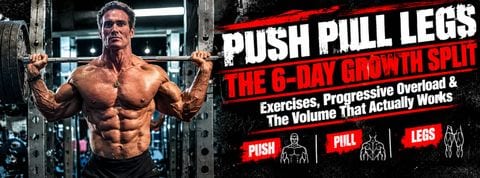
Here’s what a typical week looks like during the strength phase (weeks 5-8). This is a Push/Pull/Legs split—highly effective for natural lifters because it allows high frequency and adequate recovery.
Monday: Push (Chest, Shoulders, Triceps)
- Barbell Bench Press – 4 sets x 6-8 reps (heavy, explosive concentric, 3-second eccentric)
- Overhead Press – 4 x 6-8
- Incline Dumbbell Press – 3 x 8-10
- Lateral Raises – 4 x 12-15 (go light, focus on the burn)
- Tricep Dips or Close-Grip Bench – 3 x 8-10
- Cable Overhead Tricep Extension – 3 x 12-15
Tuesday: Pull (Back, Biceps, Rear Delts)
- Deadlift – 4 x 5-6 (yes, it’s a pull. Grip it and rip it—but with good form)
- Pull-Ups or Lat Pulldowns – 4 x 6-8 (add weight if bodyweight is easy)
- Barbell Rows – 4 x 8-10
- Face Pulls – 3 x 15-20 (rear delt health = shoulder longevity)
- Barbell Curls – 3 x 8-10
- Hammer Curls – 3 x 10-12
Wednesday: Legs (Quads, Hamstrings, Calves)
- Back Squat – 4 x 6-8 (ass to grass, or at least parallel)
- Romanian Deadlifts – 4 x 8-10
- Leg Press – 3 x 10-12
- Walking Lunges – 3 x 12 per leg
- Standing Calf Raises – 5 x 15
- Seated Calf Raises – 4 x 20
Thursday: Rest / Active Recovery
Go for a walk, do some mobility, or just nap. Naps are anabolic.
Friday: Push (Hypertrophy Focus)
Same as Monday but with slightly lighter weights, higher reps (10-12), and shorter rest (60 seconds). Add a drop set on the last set of bench press and lateral raises.
Saturday: Pull (Hypertrophy Focus)
Same as Tuesday but with higher reps (10-15) and include a bicep superset: barbell curls immediately followed by dumbbell curls to failure.
Sunday: Rest / Eat Everything in Sight (within reason)
Progression: Each week, try to add 2.5-5 lbs to your main lifts (bench, squat, deadlift, overhead press). If you hit the top of the rep range with perfect form, add weight next session. That’s progressive overload in action.
Nutrition for Mass: Eating Like It’s Your Job
You cannot build a house without bricks. You cannot build muscle without a caloric surplus. If you’re not gaining weight, you’re not building muscle—period. End of story.
The Numbers
- Calories: Aim for 300-500 calories above maintenance. Use an online TDEE calculator to find your maintenance, then add 300-500. If after 2 weeks you haven’t gained 0.5-1 lb, add another 200 calories.
- Protein: 0.8-1 gram per pound of bodyweight. Chicken, beef, eggs, Greek yogurt, whey. Yes, you will be eating a lot of chicken. Chicken is your new best friend.
- Carbohydrates: 2-3 grams per pound. Carbs are not the enemy; they fuel training and spike insulin, which is anabolic. Rice, oats, potatoes, fruit.
- Fats: 0.3-0.5 grams per pound. Don’t go too low—hormones need fat. Avocado, nuts, olive oil, fatty fish.
Humor Break: The “Dirty Bulk” Trap
Some bros think a 12-week mass building program means eating three large pizzas a day. That’s called a dirty bulk, and it leads to a physique that’s more “soft and puffy” than “big and strong.” You’ll gain 15 pounds, but 10 of it will be fat. Then you’ll have to cut, and you’ll be miserable. Eat clean, whole foods 80-90% of the time. A cheeseburger once a week won’t kill you, but if your daily diet looks like a fast-food menu, you’re doing it wrong.
Recovery & Sleep: The Forgotten Growth Hormone
Muscle grows when you rest, not when you train. Training breaks muscle down; recovery builds it back up stronger. If you skimp on sleep, you’re leaving gains on the table.
- Sleep 7-9 hours per night. Growth hormone and testosterone are released during deep sleep. Poor sleep = poor recovery = poor gains.
- Manage stress. Chronic cortisol elevation inhibits muscle growth and promotes fat storage. Take a walk, meditate, or yell at the TV—whatever lowers your stress.
- Rest days are not optional. Your 12-week program includes 2 full rest days per week. Do not train seven days a week. That’s not dedication; that’s stupidity.
Supplements: Keep It Simple, Save Your Money
The supplement industry wants you to believe you need 47 products. You don’t. Here’s the science-backed, no-BS list:
- Creatine Monohydrate: 5g daily. It’s the most researched supplement in history. It works. Take it every day, forever.
- Protein Powder: Only if you struggle to hit your protein target through food. Whey is convenient.
- Caffeine: Pre-workout or coffee. Improves performance and focus. Don’t overdo it.
That’s it. Everything else is either proven ineffective or costs more than it’s worth.
Common Mistakes That Kill Your Gains (And How to Avoid Them)
1. Ego Lifting
You’re not impressing anyone by quarter-squatting 405. Use a weight you can control through a full range of motion. If you have to bounce the bar off your chest, it’s too heavy.
2. Training Too Much
More is not better. Your muscles grow outside the gym. If you’re doing 30 sets per body part per week and feeling exhausted, you’re overtraining. Stick to the plan.
3. Not Eating Enough
This is the #1 reason skinny guys stay skinny. You think you eat a lot, but you probably don’t. Track your calories for one week. You’ll be shocked.
4. Skipping Leg Day
Don’t be that guy with the huge upper body and chicken legs. Squats and deadlifts release the most testosterone and growth hormone naturally. Train legs hard.
5. Changing Programs Too Often
Commit to the 12 weeks. Don’t hop to a new program after 4 weeks because you didn’t see overnight results. Trust the process.
Final Thoughts: The Iron Is Patient
A 12-week mass building program won’t turn you into Ronnie Coleman, but it will add noticeable size and strength if you follow it with discipline. You’ll look in the mirror at week 12 and smile—not because you’re perfect, but because you’re better than you were at week 1.
The barbell doesn’t care about your excuses. It’s always there, waiting. Show up, lift heavy, eat big, sleep deep, and laugh at the soreness. Because one day, you’ll look back and realize those 12 weeks were the best investment you ever made.
Now go eat some chicken and do some squats.
The Elephant in the Room: A Candid Note on Steroids
Alright, let’s address the 800-pound gorilla (or should I say, the 250-pound shredded gorilla) standing in the corner of the gym. You’ve read this whole program, you’re excited to start, but a little voice in your head is whispering, “What about steroids?”
I’m not here to lecture you or pretend they don’t exist. I’m not your mom, and I’m not the DEA. I’m a coach, and part of being a coach is honesty. So here’s the truth: steroids work. They absolutely, undeniably, scientifically work. They increase protein synthesis, speed up recovery, and allow you to build muscle beyond your natural genetic ceiling. Anyone who tells you otherwise is either lying, ignorant, or selling you a $47 "natural testosterone booster" that’s really just zinc and prayers.
We can’t pretend that the biggest guys on stage or on your social media feed got there on chicken and creatine alone. Many didn’t. And that’s a reality of the sport. Does that diminish the hard work they put in? Hell no. You still have to train like an animal and eat until you hate food. But the drugs give them a bump—sometimes a huge one.
So, if you’re considering taking the plunge, here’s the only advice I’ll give you, and I want you to tattoo it on your brain: cycle on, cycle off, and don’t abuse the gear.
That means:
- Do your research. Know exactly what you’re putting in your body, the side effects, and how to mitigate them.
- Get blood work. Before, during, and after. If you’re not willing to monitor your health, you have no business touching PEDs.
- Respect the off-cycle. Your body needs time to recover its natural hormone production. Coming off is just as important as being on. Running year-round cycles is how you end up with a heart the size of a basketball and testicles the size of raisins.
- Don’t chase the dragon. More is not better. A gram of tren a week will not make you Mr. Olympia, but it will make you a candidate for an early grave. Use the minimum effective dose, not the maximum tolerated dose.
I’m not endorsing illegal drug use, and I’m certainly not telling you to do it. This 12-week program will work beautifully without any of that. But if you’re an adult, and you decide to go that route, do it with your eyes open, your doctor on speed dial, and a plan to come off. The goal is to be jacked and healthy—not just jacked for a few years before your body gives out.
Now, whether you’re natural or enhanced, the same rule applies: train hard, eat smart, recover like it’s your job, and respect the process. The iron doesn’t care how you got there—it only cares that you showed up.