


GHK-Cu
Copper-binding tripeptide studied for collagen, elastin and tissue remodelling - mechanism, evidence and light-sensitive handling.
2 products.
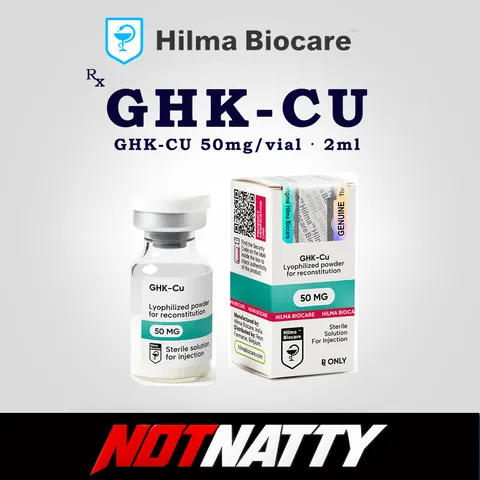
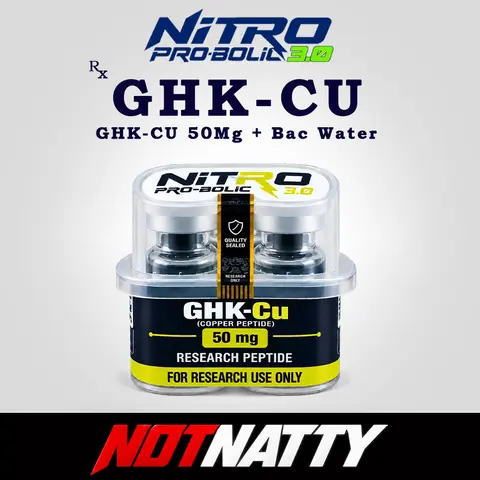
GHK-Cu: Copper, Collagen and Tissue Remodelling
GHK-Cu is a copper-binding tripeptide - glycine, histidine and lysine - first identified in human plasma. It is one of the few appearance-oriented compounds with a genuine mechanistic literature behind it, although the gap between mechanism and cosmetic result remains wide.
What the Peptide Does
GHK-Cu is studied for tissue remodelling. It influences collagen synthesis, elastin production and angiogenesis, and it regulates a set of genes involved in wound repair and extracellular matrix turnover.
The copper is functional, not decorative. The peptide delivers copper to cells in a form that participates in enzymatic reactions, and the copper-peptide complex is more active than the peptide alone. That is why the compound is usually a blue-tinted solution or powder.
Skin Research
In skin models, GHK-Cu has been studied for collagen density, skin firmness and recovery after injury. Some human cosmetic research exists, but it is small and often industry-funded.
The mechanistic story is credible: collagen and elastin are the structural proteins that decline with age, and GHK-Cu is studied for increasing their synthesis. Whether that translates into visible change over weeks is a different question, and the literature does not settle it.
Hair Research
Hair interest centres on the follicle environment rather than on hair growth directly. GHK-Cu is studied for blood supply to the follicle and for the extracellular matrix around it.
That is a meaningful distinction. A treatment that improves follicle environment is not the same as a treatment that regrows hair, and no peptide in this category has strong evidence for the latter.
Delivery Routes in the Literature
GHK-Cu has been studied topically, by injection and in cosmetic formulations, and the route changes what the data can tell you. Topical work focuses on skin appearance and barrier function; injected work focuses on tissue remodelling at a systemic level.
That matters for interpretation. A topical cosmetic study cannot be used to support an injectable protocol, and an injectable tissue-repair study cannot be used to sell a cream. The evidence has to match the route.
Light and Temperature Sensitivity
GHK-Cu degrades with light exposure. Store the powder and any reconstituted solution away from direct sunlight, and keep the vial in its carton where possible.
Reconstituted peptide belongs in the fridge at 2-8°C. Avoid repeated warming; take the vial out, draw, and return it promptly.
What the Evidence Does Not Support
Marketing often presents GHK-Cu as a collagen injection that visibly reverses skin ageing. The research supports collagen synthesis as a mechanism, not a guaranteed cosmetic outcome.
Similarly, claims about hair regrowth outrun the data. The honest framing is tissue quality and follicle environment, which are measurable, rather than appearance, which is not.
What This Page Offers
Listings state vial size, purity documentation and live stock. This page covers mechanism, evidence and handling; the product page carries the full specification and buying details.
Buying GHK-Cu Online
GHK-Cu research overview: the copper-binding tripeptide studied for collagen, elastin and tissue remodelling, with handling and storage guidance.