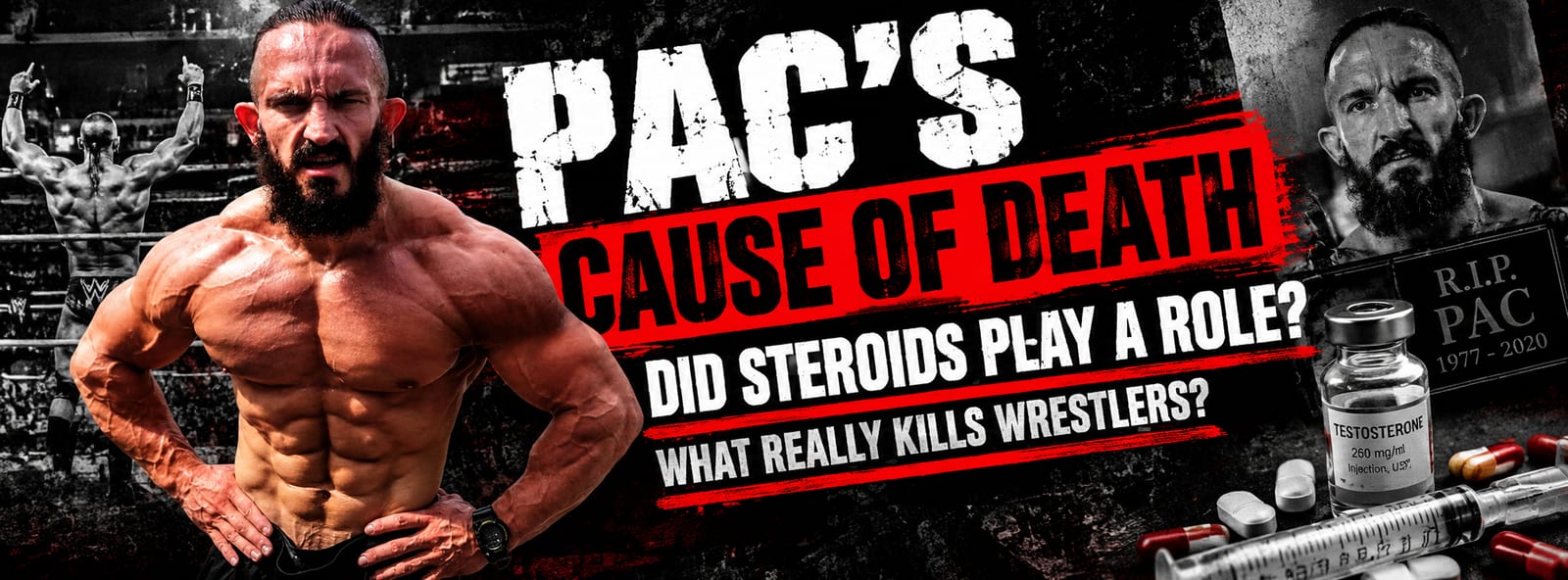
PAC (Benjamin Satterley) died at 40 with cause of death pending toxicology - the public verdict came first. The real pattern: years of abuse and zero heart checks.
Benjamin Satterley - PAC to AEW fans, Neville to anyone who watched his WWE run - was found dead in a rental car in a Des Plaines, Illinois parking lot on September 27, 2026. He was 40 years old, had wrestled the night before at All Out near Chicago, and was minutes from the airport and a flight home to the United Kingdom. The autopsy has been performed. The cause of death has not been released: the Cook County Medical Examiner says toxicology and additional testing may take weeks. Police report no foul play, no signs of suspicion, nothing. So the honest headline is: nobody knows yet.
Nobody in the medical examiner's office knows. The internet knew on day one - it always does. Within hours the comment sections, the shorts, and the quote-tweets had the same villain on trial: steroids. This article is not going to pretend that question does not exist. It is going to do something rarer: wait for the actual pattern, because when you line up the wrestlers, bodybuilders, and powerlifters who died young or got the scare of their lives, the steroid question is the wrong first question - and the right one is almost never asked out loud.
What Is PAC's Cause of Death? What We Actually Know
Strip away the speculation and the record is small and precise. On Saturday night, September 26, PAC wrestled Andrade El Idolo at AEW All Out at the NOW Arena in Hoffman Estates. On Sunday afternoon he was found "unresponsive, slumped over, in a vehicle" outside a Cava restaurant near O'Hare International Airport after a 911 call at roughly 3:53 p.m. Witnesses told the dispatcher they had been banging on the window for five minutes. He was pronounced dead at 4:08 p.m. His phone was still open with Google Maps routing him to the terminal; he was flying home to the UK.
The incident report notes saliva on his shirt and medication found in the vehicle - the name of the medication was redacted - and nothing of note in his pockets or backpack, no injuries suggesting violence, no suspicious circumstances. TMZ confirmed the investigation found no foul play, and F4WOnline's report on the incident added only the flight details - no answers. A man who had just turned 40 in August, in good enough condition to work a national-level wrestling match 24 hours earlier, was gone in a parking lot. That is the entire known record. Everything after that sentence is someone's theory wearing a press badge or a profile picture.
The Verdict Arrived Before the Autopsy Did
Every sudden death in this industry follows the same script. The man is young, muscular, and enhanced-adjacent by profession, so the timeline fills with confidence: "steroids." The same instinct powers the entire natty-or-not machine - the accusation gets views, the denial gets views, and nothing ever has to be proven. This site has documented how that circus works with The Rock, the Instagram natty lie, and Liver King's confession: the conclusion is always pre-assembled, and facts are decorative. The difference is those are living men being measured for their physiques. PAC is a man whose cause of death is legally, medically, still open - and the crowd already closed the case.
Here is why that matters beyond basic decency. If the reflex answer is always "steroids," then nobody has to look at the answers that repeat in every actual coroner's report: years of heavy use with no screening, undetected heart disease, blood pressure nobody measured, sleep apnea nobody treated, and a checkup the man last had in high school. "Steroids" is a mood. The common denominator is a pattern - and patterns can be fixed.
The Common Denominator in Every Early Death
Run the obituary column of this industry and the causes of death get specific fast. Eddie Guerrero was 38 when he died of acute heart failure in 2005 - a man whose past of heavy use was described by the medical examiner's findings on his worn, narrowed blood vessels. Davey Boy Smith, the British Bulldog, was 39 when a heart attack killed him in 2002; the inquest found an enlarged heart, with steroids in his system the coroner judged not life-threatening on their own. Rick Rude was 40, dead of heart failure in 1999, with mixed medications flagged on the autopsy report as well. Young men, heart disease, every one of them - and in every story the same sub-line: the abuse had been going on for years, and nobody had been looking at the one organ doing the load-bearing work.
Now run the survivor column. Arnold Schwarzenegger is 79. Frank Zane is 84. Robby Robinson is 79 and still training. Sylvester Stallone is 80 and still working - and he just handed the cycling argument its best celebrity witness: ahead of his memoir, he confirmed the Rocky III steroid years but described the only acceptable way to do it as "in a sensitive way - six weeks on, six weeks off," then decades of doctor-managed testosterone and HGH. The men who came up in the 1960s and 1970s - the original boogeymen of the steroid panic - are largely still with us, many of them outliving their own generation of naturals. Whatever else separates the two columns, one variable is ugly and consistent: the dead ones were on for years at doses that kept climbing, with zero blood work, zero echocardiograms, and a philosophy that "feeling fine" counted as a diagnosis. The survivors cycled, came off, moderated, and - the unglamorous part - kept getting checked. Use has a decades-long safety record in that column. Abuse has a body count. That is not a theory; it is the math of how much these compounds actually do versus how much people take anyway.
The Triple H Lesson: The Scan Only Comes in an Emergency
In September 2021, WWE issued a sterile four-line statement: Paul Levesque, better known as Triple H, had undergone a procedure at Yale New Haven Hospital following a cardiac event, "caused by a genetic heart issue." What that phrase hid was revealed a few months later when he sat down for interviews: a 99.9 percent blockage of the left anterior descending artery - the widowmaker - with the secondary route his heart had tried to build already clogged too. His words: he was "basically moments away."
Then came the part that should make every reader under 50 put down their phone. His father had a triple bypass at 62. His grandfather died of heart disease at 70. A great-grandfather he had only just learned about dropped dead at 52. Triple H - a man who spent three decades as the biggest athlete in every room he entered, who had access to every doctor in a billion-dollar company - did not know his own family's cardiac history, because he had never been screened for it. The defibrillator and the retirement came after. Whatever anyone believes about how a physique like his is built, the timeline is the same either way: a lifetime of being watched, measured, and photographed, and not one scan of the muscle that mattered, until it was nearly too late to matter.
Abuse, Not Use: The Line Nobody Wants to Draw
Let's define the words the way the coroner's office would. "Use" is purposeful: a dose for a goal, a finite window, blood work before and after, a proper off-period, and the humility to stop when the markers say stop. "Abuse" is years - constant exposure, doses climbing because the receptors stopped listening, no bloods, no echo, no downtime, painkillers for the joint damage, and a refusal to test anything except the urine the employer demands. It is the blast-and-cruise-for-a-decade lifestyle where the cruise never actually cruises and the bloods never actually happen.
That distinction answers the question the comment section keeps asking. Nobody dies of the first cycle. Nobody's kidney shuts down from a twelve-week block with monitoring - the men in our first cycle guide are told to get bloods for exactly this reason. What kills, what shows up as an enlarged heart on an autopsy table at 39, is a decade of unmonitored megadoses stacked on the same coronary arteries that were fine at the start. The common denominator among the wrestlers who died and the wrestlers who nearly did is never "he took steroids." It is "he took everything, for years, and never once looked."
The Bottle-vs-the-Pills Truth
Here is the part of the pharmacology the panic never includes, because it does not fit the morality play. Anabolic steroids are not acutely poisonous in the way the medicine cabinet actually is. There is no well-documented dose of injectable testosterone that a healthy adult injects and dies from that afternoon - the acute lethal thresholds emergency rooms track belong to entirely different shelves. Take a bottle of NSAIDs - ibuprofen, naproxen, diclofenac - and you can put yourself in acute kidney failure and hemorrhage your stomach lining. Take a bottle of aspirin and you can kill yourself outright; aspirin overdose is a classic, documented poison-control fatality, with ringing ears giving way to heat, confusion, and acidosis.
Nobody is saying ten bottles of oil is a good idea either - the blood pressure alone would be an experience, and dirty product brings its own acute problems, from abscesses to underground lab contamination. The point is directional. Steroids kill with time and neglect - the slow, boring, cardiovascular kind - not with the instant organ-failure overdose the memes sell. And that is exactly why the abuse pattern is the killer: you cannot feel a coronary artery narrowing, so years of unmonitored abuse never feel like anything at all. The testing-window crowd already understands invisible risk - see the detection times chart for what invisible looks like when it works in your favor. The same indifference works against you when it is your left ventricle instead of your next urinalysis.
Everyone Should Get Checked - Yes, Everyone
Wrestlers get wellness-tested: urine in a cup, banned substances, a signature. Not one organization in the industry puts its talent on an echocardiogram table annually, and the muscle magazines do not either. Meanwhile the actual screening that would catch the pattern is cheap and boring: blood pressure at home, a lipid panel, an ECG as a baseline, an echocardiogram if you have any family history or have ever spent years enhanced - which, for this audience, is the target demographic for our steroid blood work panel guide. If you have never touched a vial, you should still want the echo. Heart disease is the leading killer of the people who warn you about steroids, too - it does not check your browsing history first.
The Bottom Line
PAC's cause of death is pending, and this article will not pretend otherwise - if the toxicology comes back with a connection to PEDs, that belongs in the record like everything else. But the record of the last forty years already shows the pattern that actually matters: abuse for years with zero monitoring is what kills, disciplined use with blood work has a survivor column full of men in their seventies and eighties, and the one thing every dead wrestler had in common with every nearly-dead one is that nobody ever looked at their heart until it was an emergency. You can blame steroids when the results arrive. Get your own checked now, regardless of what you take, regardless of what you will ever take - because the parking lot is not a place where opinions are useful, and the scan you can book this month is worth a thousand comments already written.
PAC, Steroids, and Heart Checks FAQ
- What is PAC's cause of death - did steroids kill him? Nobody knows yet. The medical examiner has performed the autopsy but says cause and manner are pending toxicology and additional testing that may take several weeks; police found no foul play. Anyone stating a cause today is guessing loudly.
- Is steroid use a death sentence? No. The survivor column includes the 1970s bodybuilders still alive in their late seventies and eighties - Arnold is 79, Frank Zane is 84, Robby Robinson is 79. The deaths cluster around a different variable: years of abuse with no screening.
- What do the early wrestler deaths have in common? Not the substance - the timeline. Eddie Guerrero (38), Davey Boy Smith (39), and Rick Rude (40) all died of heart-related causes before 41, after years of heavy use with no cardiac monitoring recorded in any of their stories.
- Should you get your heart checked even if you don't use steroids? Yes. Blood pressure, a lipid panel, and a baseline ECG are worth having for anyone; add an echocardiogram if you have family history of heart disease or any history of enhancement. Our blood work panel guide lists what to ask for.
- Was Triple H's cardiac event caused by steroids? His own account attributes it to genetics: a 99.9 percent widowmaker blockage plus a family history of heart disease he had never been screened for, as WWE's statement also said. The lesson survives either answer - he was not scanned until his heart was already failing.