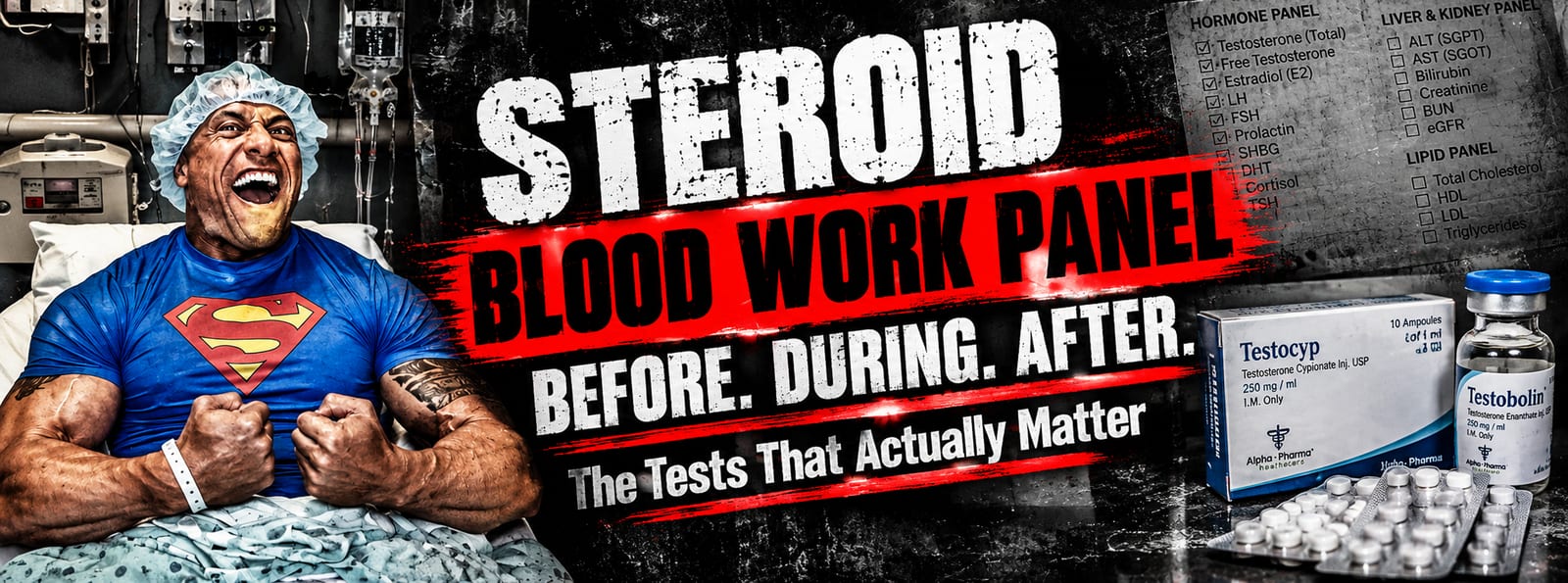
The steroid blood work panel that keeps you honest: baseline, week 6-8, and post-PCT timing covering testosterone, estradiol, hematocrit, lipids, liver and recovery markers.
Run bloods three times around any cycle: a baseline before you inject anything, a mid-cycle draw around weeks 6 to 8, and a follow-up 4 to 8 weeks after you finish PCT. The core panel is total testosterone (free testosterone ideally), estradiol, a CBC with hematocrit, a lipid panel, liver enzymes, kidney markers, and LH/FSH when you are checking whether your system came back online - plus prolactin if you ran a 19-nor, and thyroid only if you use T3. Blood work is the only honest feedback loop you get on gear: everything else is guesswork, labels that may be lying, and how you feel - and how you feel is a terrible lab.
Why Blood Work Is the Only Honest Feedback Loop on Gear
Everything else lies to you. Underground labels can underdose, overdose, or contain something else entirely. Training partners lie about their doses. Mirror checks are biased by pump, lighting, and denial. Crashing lipids, climbing hematocrit, rising liver enzymes - none of that hurts enough to feel, which is exactly the problem. Polycythemia and elevated liver enzymes are silent right up until they are not.
Blood work closes the loop: whether the compound is doing what it claims, whether your estrogen strategy works, whether your organs tolerate the dose. If you inject at all, know how to inject - sites and technique first. And whether your testosterone comes from a pharmacy or a gym bag, the panel is identical - TRT versus underground testosterone is a sourcing question, but bloods only show what ended up in your bloodstream.
When to Draw: Baseline, Mid-Cycle, Post-PCT
Baseline comes first. Get bloods before you start anything - without a baseline, your mid-cycle numbers are just numbers. Already on stable TRT? Your baseline is your current state; draw now.
Mid-cycle lands around weeks 6 to 8 - late enough for hormones and hematocrit to reflect the compound, early enough to change course before damage accumulates. Oral-only runs: draw earlier, orals hit lipids and liver fast.
Post-cycle comes 4 to 8 weeks after finishing PCT, not the day it ends - drawing too early reads as failure when it is just lag. PCT 101 walks the recovery timeline; labs verify it worked. On long-term TRT or blasting and cruising, plan ongoing draws every 6 to 12 months minimum.
The Core Panel, Marker by Marker
Ask for these by name. A standard physical will not cover all of them.
Hormones
- Total testosterone, ideally with free testosterone - the number your dose is trying to move. Roughly 300 to 1000 ng/dL is a commonly cited male reference range, but what matters is your baseline, not the lab's midpoint.
- Estradiol (E2) - your estrogen marker, and the one that shows whether your management strategy (see arimidex versus aromasin) is doing its job.
- LH and FSH - the suppression markers. They show whether your pituitary is still signaling and, post-cycle, whether recovery is genuinely happening.
- Prolactin - relevant the moment you run a 19-nor like tren or NPP. See trenbolone's nightmare side effects and the NPP guide for why prolactin matters.
- T3 - only if you are using thyroid hormone. Users are covered in the T3 (Cytomel) guide.
Blood, liver, kidneys, and lipids
- CBC with differential - hematocrit and hemoglobin are the headline. Polycythemia risk is real on testosterone and 19-nors - this is the marker that changes what you do next.
- Lipid panel - HDL, LDL, triglycerides. Orals wreck HDL, and winstrol is notoriously the worst offender; anavar is milder but still moves lipids.
- Liver enzymes (ALT/AST) - the hepatotoxicity marker for 17-alpha-alkylated orals. Normal numbers do not license permanent abuse; they license continuing today.
- Kidney markers (creatinine/eGFR) - less about the drug and more about bodybuilding itself - high protein intake, mass phases, and bodyweight swings move these independent of anything you injected.
How to Actually Read the Results
Start from your baseline. A hematocrit of 50% means one thing if you came in at 44, another if you came in at 48 and climbed. Trends beat snapshots, and your trend beats the lab's printed reference range.
Numbers work with symptoms, never instead of them. Estradiol "in range" is not the same as your optimal range - plenty of guys feel flat or libido-crashed while the lab insists everything is normal. That gap between the printed range and your working range is where gyno decisions get made and AI choices get second-guessed at 2am. Read both columns together, not a single flagged value.
On hematocrit, roughly 54% is a commonly cited threshold where doctors start getting concerned - below it many will watch, above it many will talk donation or dose reduction. Treat it as a tripwire, not a grade you can ignore at 53%. HDL recovery after stopping orals takes weeks, not days, so a lipid panel drawn two days after your last tablet snapshots the damage, not the recovery.
Logistics: Morning Draw, Fasted, Nobody Cares
Draw in the morning. Testosterone is diurnal - it peaks overnight and declines through the day, so an 8am draw and a 6pm draw are not comparable, and mixing timepoints makes trends meaningless. Fast 8 to 12 hours if lipids and glucose are on the panel; black coffee and water are fine. Hydrate - a dehydrated draw skews hematocrit upward, the last thing you want when watching that number.
Tell the lab nothing unusual, because nothing unusual is happening. A testosterone test is one of the most routine requests in clinical medicine - men on cypionate get them every few months and nobody blinks. Self-pay and private labs exist in many countries, TRT clinics and ordinary doctors run these panels as standard, and you do not need an excuse for wanting a baseline.
Ongoing Monitoring for the Long-Term User
On TRT or blasting and cruising indefinitely, the cycle schedule collapses into a rhythm: bloods every 6 to 12 months when stable, sooner whenever you change compound or dose. The same panel applies, because none of those risks retire just because you stopped calling them "cycles."
Users adding growth hormone have their own reasons to stay monitored; the HGH dosage guide covers how it fits into a protocol. Whatever the stack: your next decision about dose, compound, or whether to continue should come from a piece of paper with your name on it, not a mirror. Choosing a compound for your goal is step one - proving your body tolerates it keeps step one from being the last decision you make.
The Bottom Line
Baseline before you start, mid-cycle around weeks 6 to 8, post-PCT 4 to 8 weeks after recovery ends, every 6 to 12 months if you cruise long-term. The panel: total and free testosterone, estradiol, CBC with hematocrit, lipids, liver enzymes, kidney markers, LH/FSH, prolactin on 19-nors, thyroid only on T3. Read trends against your baseline, pair numbers with symptoms, and treat hematocrit and HDL like the tripwires they are. Blood work is not paranoia - it is the only feedback loop that cannot lie to you about gear.
Steroid Blood Work FAQ
- What bloods should I run before steroids? Total and free testosterone, estradiol, CBC with hematocrit, lipids, liver enzymes, kidney markers, and LH/FSH - drawn before you touch anything, so you have a real baseline for every later draw.
- How often should you get bloods on cycle? Once around weeks 6 to 8 for a standard cycle, earlier for oral-only runs, and again post-PCT. Extra symptom-driven draws are fair game if something feels off.
- What hematocrit level is dangerous? Roughly 54% is the commonly cited threshold where doctors get concerned. Sustained numbers above that prompt dose reduction, donation, or further workup - a tripwire to act on, not a number to panic over.
- Do I need bloodwork after PCT? Yes - draw 4 to 8 weeks after finishing PCT to confirm testosterone, estradiol, LH, and FSH recovered. Drawing the day PCT ends reads as false failure - recovery lags the last pill.
- Where can I get bloodwork done privately? Self-pay and private labs operate in many countries, and TRT clinics run these panels routinely. A testosterone request is ordinary - walk in fasted in the morning and nobody asks a single awkward question.
The Fine Print
This is educational content, not medical advice, and not an instruction to use any compound. Anabolic-androgenic steroids, growth hormone, insulin, and related performance drugs are controlled substances in most jurisdictions, are not approved for human use, and carry serious cardiovascular, hormonal, psychiatric, and legal risks. Talk to a licensed doctor, run real blood work, follow your local laws, and — if you compete — your sport's anti-doping rules. Nothing here is a prescription, and no outcome is guaranteed.
Content last reviewed: September 29, 2026 · NotNatty.cc is informational only and is not a substitute for professional care.

 Alpha Pharma