
 Original
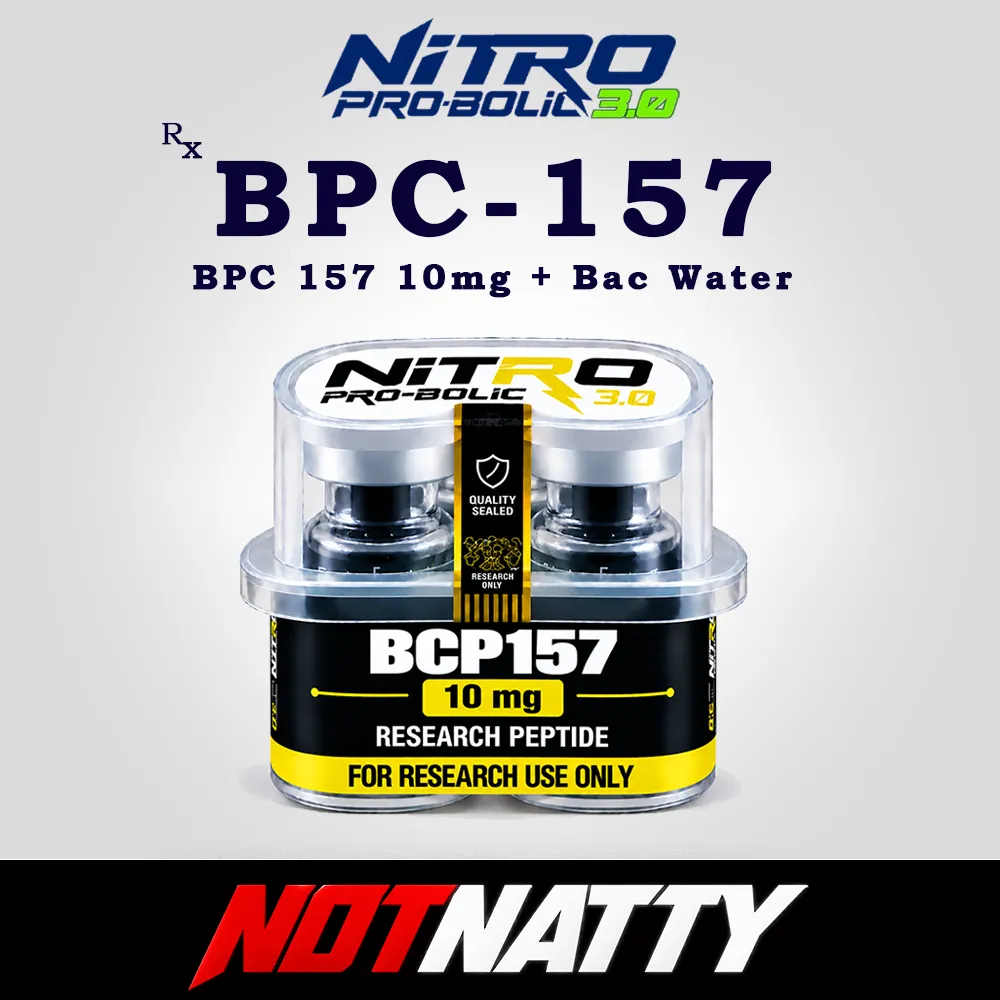
BPC-157 10mg
BPC-157 Research Peptide – Body Protection Compound for Tissue Repair & Recovery Research
Product Details
Key specs at a glance
Shipping & Logistics
Nitro Peptides — USA (Domestic) shipping
 Ships from
USA
Ships to
USA
USPS Priority - arrives within 1 week — $40.00 shipping (USPS Priority)
Buy 3 & get 1 FREE
Add 3 to your cart — the 4th unit is automatically FREE at checkout. No code needed.
Secure Shopping
Your data is protected with the highest security standards.Want to buy Wholesale?
Get exclusive discounts on orders over $1,500 — contact us.Description
BPC-157 Research Peptide – Body Protection Compound for Tissue Repair & Recovery Research
BPC-157 (Body Protection Compound-157) is a synthetic pentadecapeptide — a 15-amino-acid sequence derived from a protein found in human gastric juice. In the research literature, it is one of the most extensively investigated peptides in preclinical models of tendon, ligament, and muscle healing, earning the colloquial moniker “the Wolverine Peptide” for its studied association with accelerated tissue repair.
This research-grade BPC-157 is supplied as a sterile, lyophilized powder, independently verified by HPLC-UV (≥99% purity) and LC-MS identity confirmation, with a batch-specific Certificate of Analysis for full traceability. This is research-grade material — not an unverified “research chemical.”
Proposed mechanisms of interest in preclinical literature:
Angiogenesis & microvascular support: BPC-157 promotes the growth of new blood vessels and has been shown to increase vessel density and accelerate blood flow recovery in animal models. Research has identified a novel molecular axis — the BPC157–FBXO22–BACH1 pathway — through which the peptide drives angiogenesis. It has also been shown to enhance VEGF expression, endothelial proliferation, and eNOS phosphorylation via Src–Caveolin-1 signaling.
Fibroblast activation & collagen synthesis: BPC-157 accelerates tendon and ligament repair through enhanced fibroblast proliferation and collagen synthesis, primarily via focal adhesion kinase (FAK)–paxillin signaling pathways. It also enhances growth hormone receptor expression and several pathways involved in cell growth.
Musculoskeletal tissue repair: In preclinical models, BPC-157 improved functional, structural, and biomechanical outcomes in muscle, tendon, ligament, and bony injuries. Healed tendons have shown increased load-to-failure and significantly higher functionality, as indicated by the Achilles Functional Index over 14 days. The peptide has demonstrated healing effects even in the presence of corticosteroids, which typically impair recovery.
Inflammatory pathway modulation: BPC-157 has been shown to reduce inflammatory cytokines while supporting tissue repair, consistent with its study in gastrointestinal mucosal protection and homeostasis models.
An important research context: The translational gap between animal models and human outcomes remains substantial. As of the most recent systematic reviews, only a handful of published human studies exist — including a retrospective review in which 7 of 12 patients with chronic knee pain reported relief for more than six months following intra-articular injection. BPC-157 is metabolized in the liver with a half-life of less than 30 minutes and is cleared by the kidneys.
Product specifications:
Compound: BPC-157 (Body Protection Compound-157)
Sequence: Gly-Glu-Pro-Pro-Pro-Gly-Lys-Pro-Ala-Asp-Asp-Ala-Gly-Leu-Val
CAS Number: 137525-51-0
Molecular Formula: C₆₂H₉₈N₁₆O₂₂
Molecular Weight: 1419.54 g/mol
Appearance: White to off-white powder
Form: Lyophilized powder
Purity: ≥99% by HPLC-UV (batch-specific COA; high-purity lots may exceed 99.4%)
Identity Confirmation: LC-MS (mass spectrometry)
Solubility: ≥2 mg/mL in H₂O
Storage (lyophilized): Store at −20°C or below, protected from light and moisture. Under these conditions, the peptide can remain stable for several years. Lyophilized BPC-157 is also relatively stable at room temperature for short periods (up to 3 weeks) during shipping.
Handling & reconstitution (research context):
For reconstitution, allow the lyophilized vial to reach room temperature before opening. Using a sterile syringe, slowly inject the desired volume of bacteriostatic water or sterile saline down the inner glass wall of the vial. Gently swirl to dissolve; do not shake or vortex, as agitation can cause aggregation and degradation. Once reconstituted, store refrigerated at 2–8°C and use within 2–4 weeks. Aliquot into single-use vials to avoid repeated freeze-thaw cycles.
Quick answers
How should I reconstitute a 10mg BPC-157 vial?
Bacteriostatic water, slow draw down the wall, never shake. At 500 mcg per day a 10mg vial covers roughly twenty doses - the practical sizing for a standard repair block. Protocol math, split dosing and injection-site logic live in the BPC-157 healing peptide bible.
Injectable or oral BPC for gut issues?
Oral for gastric complaints - stomach protection is the peptide's namesake. Injectable for tendons and ligaments, ideally near the site. The trade-off matrix is in that same guide, and the systemic partner TB-500 covers the whole-body side of recovery.
How long until a stubborn tendon notices?
One to two weeks for tendons that have been angry for months is the common report; four to six weeks for structural work. Peptides accelerate repair, rehab still directs it.
Customers Also Bought
People Also Bought




Customer Reviews
No reviews yet
Be the first to rate this product and help the community.
Only signed-in members can leave reviews.
Sign In to Review