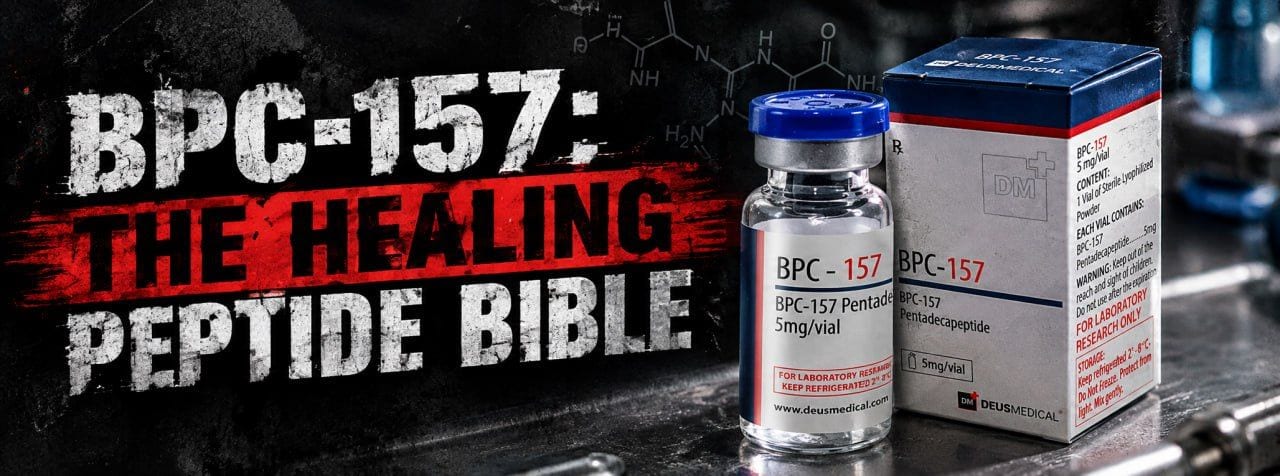
BPC-157 explained: what it is, how it works, dosage protocols, injection sites, and the honest truth about what this healing peptide can and can't do for…
BPC-157 dosage, benefits, injection sites, and the honest truth about the internet's favorite healing peptide. Here's what your source won't tell you about the pentadecapeptide.
Every gym has that guy. His elbow's been screaming for six months. He's tried foam rolling, "rehab," and a forearm sleeve that makes him look like a cyberpunk cosplayer. Then one day he starts tapping a little vial with a second-hand insulin pin, and two weeks later he's bench pressing like the injury never happened.
The vial says BPC-157.
Welcome to the most popular peptide in the bodybuilding underground — a compound with the loudest anecdotal reputation, the strictest regulatory status, and a passionate cult of believers who will fight you in a parking lot if you say it doesn't work.
Let's pull the curtain back on the peptide that everyone injects and almost nobody understands.
What Is BPC-157, Actually?
BPC-157 (Body Protection Compound 157) is a synthetic pentadecapeptide — a chain of fifteen amino acids derived from a protein found in the lining of your stomach. That origin story matters, because it explains a lot: the compound's first documented job is protecting and repairing gastrointestinal tissue.
The "157" isn't a random number, it's the specific fragment researchers isolated while studying stomach-protecting proteins. Since that discovery, BPC-157 research has piled up an impressive animal-trial record: tendon healing, ligament repair, bone fractures, ulcer healing, and even gut lining integrity.
But here's the part the Instagram experts leave out: BPC-157's entire evidence base is basically rats. Rodent studies are genuinely promising. Human randomized controlled trials for athletic recovery? Essentially nonexistent. Any influencer telling you "clinical trials prove BPC-157 rebuilds tendons" is either lying to you or lying to himself.
That doesn't mean it's worthless. It means you should understand exactly what you're buying: a fascinating, under-studied research chemical with animal evidence and mountains of gym-floor legend.
How Does BPC-157 Work?
The short version: BPC-157 appears to promote tissue repair by modulating a cascade of healing processes. Animal research points to:
- Angiogenesis: Stimulating the growth of new blood vessels, which is step one of any real healing process.
- Collagen synthesis: Helping rebuild the structural proteins of tendons and ligaments.
- Growth factor modulation: Increasing expression of factors like VEGF and IGF-1 in damaged tissue.
- Gastrointestinal protection: Its original party trick — protecting and repairing gut lining.
The mechanism that makes bodybuilders lose their minds is tendon and ligament healing. Since connective tissue is the bottleneck for anyone pushing heavy volume, a peptide that theoretically accelerates tendon repair is the missing link between "train hard" and "don't get injured."
BPC-157 Dosage: The Protocols People Actually Run
Because there are no human trials to set dosing, the community has converged on consensus protocols. Here's what the forums, coaches, and clinics doing the actual work have settled on:
The standard protocol:
| Phase | Dosage | Frequency |
|---|
| Common range | 250–500 mcg | Daily |
| Typical cycle | 250 mcg | 2× per day |
| Duration | 4–8 weeks | — |
Practical dosing guidance:
- 250 mcg twice daily is the sweet spot most experienced users report for tendon and joint recovery.
- 500 mcg daily in one shot works for guys with simpler goals or less severe issues.
- Run 4–8 weeks, then stop. BPC-157 isn't a year-round lifestyle drug; it's a targeted repair tool.
- Post-injury or post-surgery protocols often reach 500 mcg 2× daily but are typically shorter — 2–4 weeks.
Worth noting: BPC-157 is a stable peptide famously resistant to degradation, which is part of why it appears to survive the stomach when taken orally — hence the "oral BPC-157" products now floating around. But the overwhelming consensus in the community is that injectable delivery is more reliable for systemic and localized effects. Injectables give you control; orals give you an expensive probiotic. Your call.
Where to Inject BPC-157: Site-Specific or Not?
This is the pub-debate that never ends.
The locals: Some guys swear by injecting near the site of injury — the rationale being higher local concentration where the tissue actually needs repair. Injecting subcutaneously or intramuscularly close to a damaged tendon or joint is the popular approach.
The systemics: A growing camp argues BPC-157 works systemically, so location barely matters. They just pin belly or delt subQ and let the compound circulate.
The honest answer, gloves off: nobody has the human data to settle it. Both camps have real-world success stories. If you want the philosophical safety of both worlds, target the injury area when feasible and don't stress the details. Focus more on consistency than on where exactly the needle lands.
What BPC-157 Can Actually Do For You (Real Talk)
Let's set honest expectations, because the piping-hot claims you see on social media are doing everyone a disservice.
What it's most plausibly good for:
- Tendon and ligament recovery — the #1 use case. Chronic elbow pain, patellar tendonitis, shoulder issues from pressing volume.
- Post-injury turnaround — speeding up the return from strains and overuse injuries.
- Gut health support — arguably the best-documented application given its origin story, and a legitimate reason people take it.
- General recovery throughput — allowing you to handle training volume that previously flared up connective tissue.
What it is NOT:
- Not a muscle builder. Anyone selling BPC-157 as a muscle growth compound is selling you a story. It doesn't drive hypertrophy. It supports healing.
- Not a magic wand. If your elbow hurts because you bench with your elbows flared and train the same muscle eight times a week, BPC-157 will treat the symptom while your technique keeps manufacturing the injury.
- Not a steroid. It shares none of the anabolic profile you'd look for in a cycle. It's a repair tool that works alongside your gear, not instead of it.
Stacking BPC-157: The Underground Standard
Because the underground runs on stacks, here's how BPC-157 usually fits into a modern protocol:
- BPC-157 + TB-500 (Thymosin Beta-4): The classic "healing stack." TB-500 targets similar tissue-repair pathways; combining them is the most common recovery protocol in the community. (Our MK-677 guide covers the oral-GH side of the healing stack.)
- BPC-157 + GH secretagogues: Guys on CJC-1295 or ipamorelin for GH axis support often add BPC-157 during injury-prone phases like heavy strength blocks.
- BPC-157 during cutting: Bodybuilders running calorie deficits through a contest prep use it for connective tissue protection while training at high intensity on low food.
The Safety Reality Nobody Screenshots
Again: BPC-157 exists in a regulatory gray zone. In the United States, it bounced between FDA compounding categories before being placed on the "do not compound" list, and it has never been approved for human use. The entire market is research-grade product purchased from peptide suppliers, reconstituted with bacteriostatic water, and used by people who are absolutely not lab scientists.
That means your risks come in three flavors:
- Product quality risk — unregulated peptide vials vary wildly in purity. Buy from a source with traceable product and verified handling, or you're injecting water or worse.
- Reconstitution error risk — messing up BPC-157 reconstitution with bacteriostatic water means wrong doses. Read the math twice.
- Unknown long-term risk — no long-term human data exists. Anyone who claims to know the lifelong risk profile is guessing. Keep cycles limited, and don't treat it as a permanent fixture.
The Bottom Line
BPC-157 is the people's peptide for a reason: the anecdotal record is genuinely strong, the animal evidence is promising, and for connective-tissue and gut issues, it's one of the most interesting tools in the underground arsenal.
But it is not magic, it does not build muscle, and it will not fix a broken exercise routine. It's a repair compound with a legendary fan club and a thin clinical record — and the smart way to use it is exactly that way: smartly, cyclically, and in service of training that's already done properly.
Real talk for people who pin: heal the tendon, fix the technique, and keep your recovery bottleneck out of your own way.
Keep Reading
The Gear