
 Original
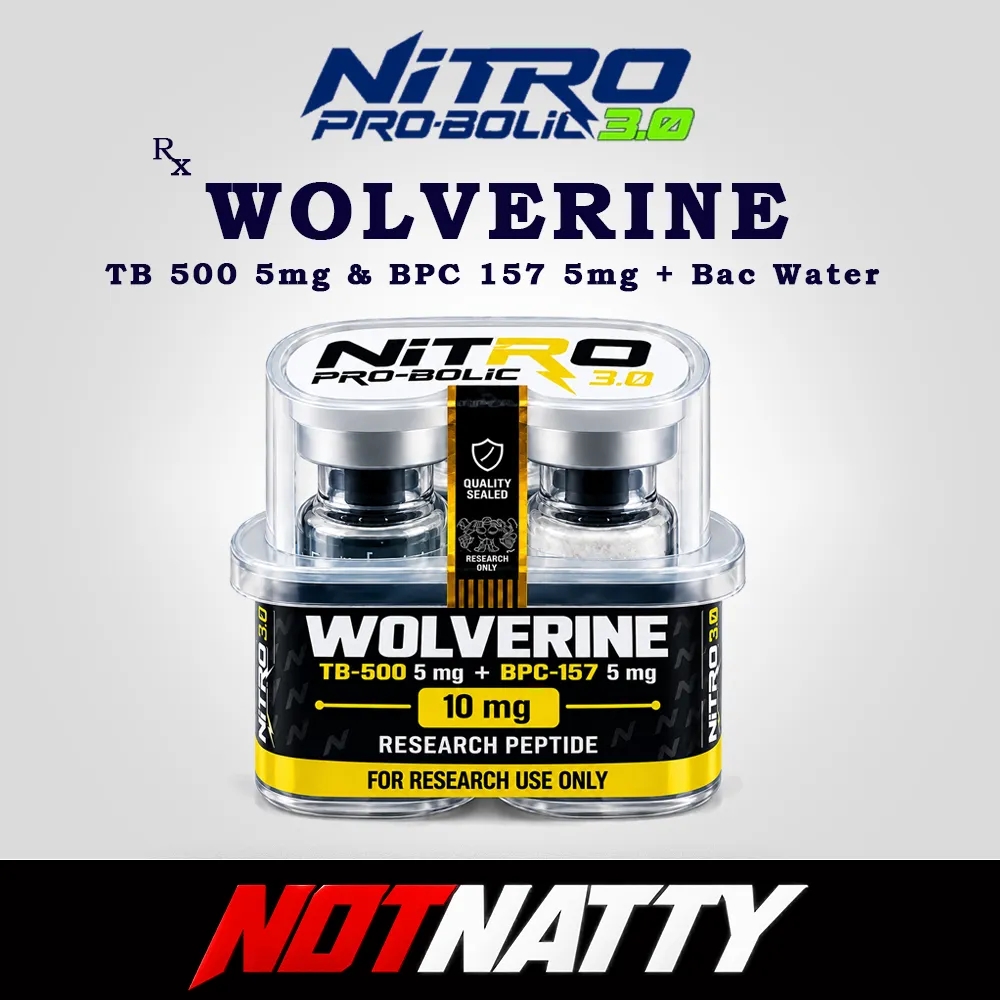
Wolverine Blend 5+5mg
The Wolverine Blend pairs BPC-157 (5mg) and TB-500 (5mg) in a single pre-formulated lyophilized vial.
Product Details
Key specs at a glance
Shipping & Logistics
Nitro Peptides — USA (Domestic) shipping
 Ships from
USA
Ships to
USA
USPS Priority - arrives within 1 week — $40.00 shipping (USPS Priority)
Buy 3 & get 1 FREE
Add 3 to your cart — the 4th unit is automatically FREE at checkout. No code needed.
Secure Shopping
Your data is protected with the highest security standards.Want to buy Wholesale?
Get exclusive discounts on orders over $1,500 — contact us.Description
The Wolverine Blend pairs BPC-157 (5mg) and TB-500 (5mg) in a single pre-formulated lyophilized vial. It is the most widely discussed combination in recovery-focused peptide research, built on a mechanistic rationale rather than a clinical evidence base: BPC-157 is studied primarily through angiogenesis and collagen synthesis pathways, while TB-500 is studied through cellular migration and actin polymerization pathways . The hypothesis is that activating these complementary mechanisms concurrently could produce additive or synergistic effects on tissue repair—a hypothesis, not a demonstrated outcome .
This 5+5 configuration delivers an equal-mass ratio of the two peptides, giving researchers a balanced starting point for dual-pathway experimental designs. Each component is independently verified, and the blend is supplied with a dual-component Certificate of Analysis confirming the presence and purity of both peptides at the stated ratio.
Proposed mechanisms of interest in preclinical literature:
Complementary, non-overlapping repair pathways: BPC-157 operates primarily through the nitric oxide system and VEGF signaling, driving angiogenesis and vasoprotection. TB-500 acts on the actin cytoskeleton and cell migration machinery, enabling cellular mobilization and architectural remodeling . Together, they address the vascular and structural dimensions of tissue biology simultaneously.
BPC-157 — “building the roads”: BPC-157 upregulates VEGF expression and increases microvessel density in histological models, modulates the NF-κB inflammatory cascade (attenuating TNF-α, IL-1β, and IL-6), and upregulates growth hormone receptor expression in tendon fibroblasts .
TB-500 — “sending the construction crews”: TB-500 binds G-actin monomers, regulating the G-actin/F-actin equilibrium that governs cell migration. It promotes the movement of repair-relevant cells—fibroblasts and endothelial cells—into damaged tissue, and is studied for anti-fibrotic activity and enhanced extracellular matrix organization .
Convergence on angiogenesis at different stages: BPC-157 acts through VEGF upregulation, while TB-500 supports endothelial cell migration. Activating both stages simultaneously is the primary rationale for the combination .
An important research context — and a critical caveat:
The synergy argument is an inference drawn from two separate preclinical literatures, not from combination data. No human clinical trial has evaluated the BPC-157 plus TB-500 combination for any indication . The most directly relevant animal study—a standardized rat Achilles tendon transection model—found that combined BPC-157 and TB-500 treatment did not confer additional benefits compared to either agent alone, despite both individual peptides improving histopathological parameters . The authors noted that the absence of additive effects may reflect convergence on shared downstream pathways, a hypothesis requiring further confirmation .
This does not invalidate the combination as a research tool; it defines the boundaries of what the current literature actually shows. Researchers designing dual-pathway protocols should treat the combination as a hypothesis-generating model, not an established synergy.
Product specifications:
Compounds: BPC-157 (5mg) + TB-500 (5mg) per vial
BPC-157 Identity: Body Protection Compound-157; CAS 137525-51-0; MW 1419.54 g/mol
TB-500 Identity: Thymosin Beta-4 active fragment; CAS 885340-08-9; MW 889.01 g/mol
Form: Lyophilized powder (single vial, pre-blended)
Purity: ≥98% by HPLC-UV per component (dual-component COA; representative lots test 99.0%+ for each peptide)
Identity Confirmation: LC-MS (mass spectrometry) for both components
Appearance: White to off-white powder
Solubility: Soluble in bacteriostatic water and sterile saline
Storage (lyophilized): −20°C, desiccated, protected from light
Handling & reconstitution (research context):
Reconstitute with bacteriostatic water using aseptic technique. Introduce the diluent gently down the inner glass wall of the vial—do not spray directly onto the powder—then swirl or roll the vial. Do not shake or vortex. Both peptides are sensitive to aggressive agitation, and TB-500’s small, strongly charged structure makes it prone to adsorption to glass and plastic surfaces at low working concentrations. Use low-binding consumables where protocol permits.
Once reconstituted, store refrigerated at 2–8°C and use within 2–4 weeks. Do not freeze reconstituted peptide. Aliquot into single-use volumes to avoid repeated freeze–thaw cycles.
Quick answers
Why take the blend over separate vials?
One reconstitution, one draw, one pin instead of two of each - and the 5+5 ratio is where most recovery protocols converge anyway. Separate vials only earn their complexity when you need to dial one peptide hard while keeping the other low; the case math for both routes is in the stack comparison.
What dosing does a 5+5mg vial support?
250-350 mcg of blend per injection, daily or every other day over four to six weeks, reconstituted with bacteriostatic water and kept cold after. The individual component guides (BPC-157, TB-500) cover the molecule-level details.
Can it run alongside an anabolic cycle?
Yes - repair peptides do not interact with androgenic suppression, no PCT angle. Recovery work keeps training volume possible while the cycle does its job.
Customers Also Bought
People Also Bought




Customer Reviews
No reviews yet
Be the first to rate this product and help the community.
Only signed-in members can leave reviews.
Sign In to Review