
 Original
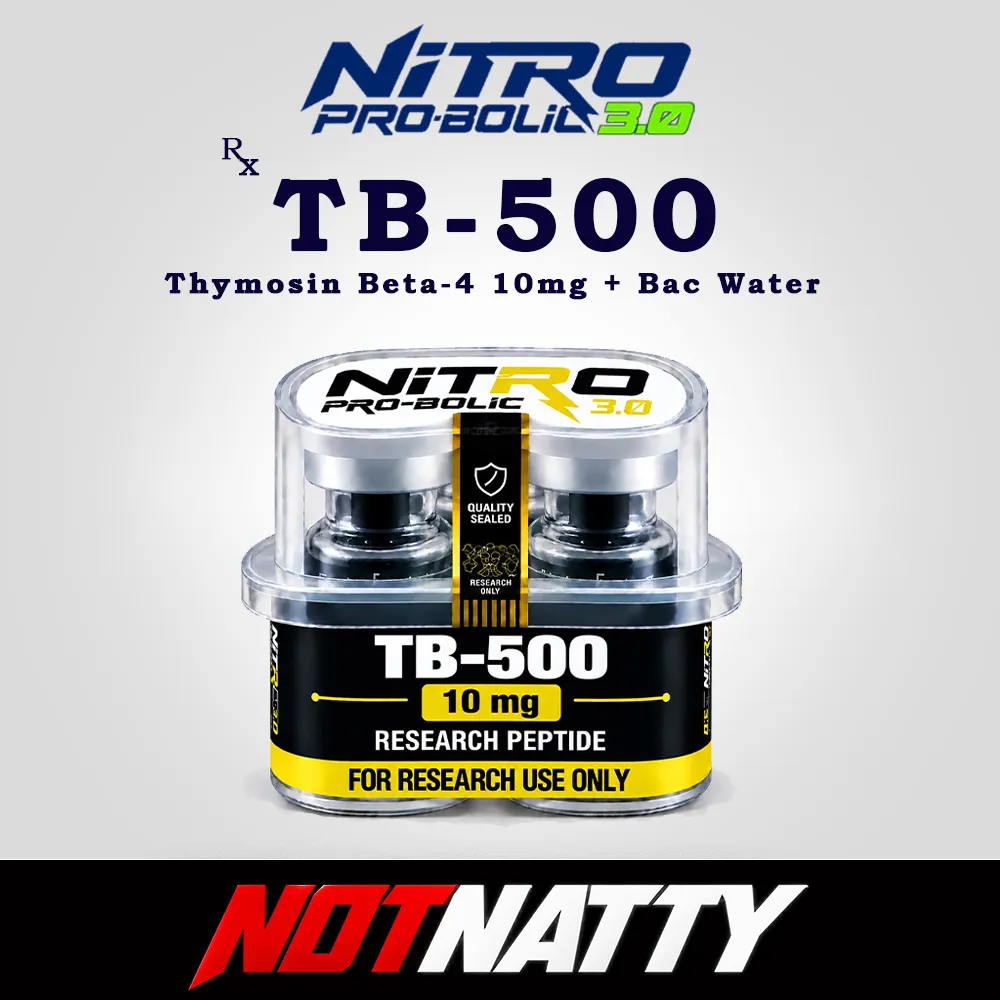
TB-500 10mg
TB-500 is a synthetic peptide corresponding to the active 17-amino-acid actin-binding region of the endogenous protein Thymosin Beta-4 (Tβ4).
Product Details
Key specs at a glance
Shipping & Logistics
Nitro Peptides — USA (Domestic) shipping
 Ships from
USA
Ships to
USA
USPS Priority - arrives within 1 week — $40.00 shipping (USPS Priority)
Buy 3 & get 1 FREE
Add 3 to your cart — the 4th unit is automatically FREE at checkout. No code needed.
Secure Shopping
Your data is protected with the highest security standards.Want to buy Wholesale?
Get exclusive discounts on orders over $1,500 — contact us.Description
TB-500 is a synthetic peptide corresponding to the active 17-amino-acid actin-binding region of the endogenous protein Thymosin Beta-4 (Tβ4). While full-length Tβ4 is a 43-residue protein, TB-500 captures the functional core—the N-terminal motif responsible for the peptide’s defining biological activity: sequestration of monomeric G-actin and regulation of cytoskeletal dynamics.
This is the mechanistic distinction that separates TB-500 from repair peptides like BPC-157. Where BPC-157 is studied primarily for localized angiogenic and fibroblast signaling, TB-500 operates upstream—controlling the cellular machinery of movement that allows repair-relevant cells (fibroblasts, keratinocytes, endothelial cells) to migrate into damaged tissue and rebuild the extracellular matrix.
This research-grade TB-500 is supplied as a sterile, lyophilized powder, independently verified by HPLC-UV (≥98% purity) and LC-MS identity confirmation, with a batch-specific Certificate of Analysis for full traceability.
Proposed mechanisms of interest in preclinical and in vitro literature:
G-actin sequestration (the core mechanism): TB-500 binds monomeric G-actin in a 1:1 stoichiometric complex, preventing its polymerization into filamentous F-actin. This maintains a ready intracellular pool of actin monomers and modulates the dynamic equilibrium between G-actin and F-actin—the balance that governs cell stiffness, polarity, and movement. The active sequence is the LKKTETQ motif, a seven-amino-acid segment that binds directly to the hydrophobic pocket between actin subdomains 1 and 3.
Cell migration and wound closure: By regulating actin dynamics, TB-500 promotes the directed migration of repair-relevant cells. In vitro, TB-500 (15–25 μg/mL over 2 days) has been shown to promote cell migration and wound healing by enhancing ATP-induced increases in intracellular calcium ions and activating purinergic P2 receptors.
Angiogenesis and endothelial differentiation: TB-500 is studied for promoting endothelial cell differentiation and angiogenesis in dermal tissue—processes dependent on endothelial cell migration and cytoskeletal remodeling.
Collagen deposition and anti-fibrotic activity: Research indicates TB-500 supports collagen deposition in wound models while exhibiting anti-fibrotic activity through inhibition of the Akt signaling pathway—a balance of promoting structural repair without excessive scar formation.
Tendon and musculoskeletal repair (preclinical): In a standardized rat Achilles tendon transection model, TB-500 administered at 60 μg/kg/day for four weeks was associated with significantly higher maximum load-to-failure values compared to controls (p < 0.05)—the only group in the study to reach statistical significance on this biomechanical endpoint. Histopathological analysis also showed improved extracellular matrix organization during early tendon repair.
An important research context: TB-500 is chemically distinct from full-length Thymosin Beta-4. The fragment lacks cysteine and methionine residues, meaning it is not vulnerable to disulfide scrambling or methionine oxidation—two degradation routes that dominate storage guidance for many peptides. Its primary stability challenge is adsorption to glass and plastic surfaces at low working concentrations, a physical loss rather than chemical degradation. Researchers should also confirm whether their material is the 17-residue fragment (TB-500) or the full 43-residue protein, as the handling profiles differ.
Product specifications:
Compound: TB-500 (Thymosin Beta-4 active fragment, Ac-Tβ4(17-23))
Sequence: Ac-Ser-Asp-Lys-Pro-Asp-Met-Ala-Glu-Ile-Glu-Lys-Phe-Asp-Lys-Ser-Lys-Leu-Lys-Lys-Thr-Glu-Thr-Gln-Glu-Lys-Asn-Pro-Leu-Pro-Ser-Lys-Glu-Thr-Ile-Glu-Gln-Glu-Lys-Gln-Ala-Gly-Glu-Ser-OH
CAS Number: 885340-08-9 (TB-500 fragment); 77591-33-4 (full-length Thymosin Beta-4)
Molecular Formula: C₃₈H₆₈N₁₀O₁₄ (fragment); C₂₁₂H₃₅₀N₅₆O₇₈S (full-length Tβ4)
Molecular Weight: 889.01 g/mol (fragment); 4,963 g/mol (full-length Tβ4)
Appearance: White to off-white lyophilized powder
Form: Lyophilized powder
Purity: ≥98% by HPLC-UV (batch-specific COA; representative research lots test 99.0%+)
Identity Confirmation: LC-MS (mass spectrometry)
Solubility: Soluble in bacteriostatic water and sterile saline
Storage (lyophilized): −20°C, desiccated, protected from light and moisture. Under these conditions, stability is measured in years.
Handling & reconstitution (research context):
Introduce the diluent (bacteriostatic water or sterile saline) gently down the inner glass wall of the vial rather than spraying directly onto the powder. Swirl or roll the vial to dissolve—do not shake or vortex. TB-500 dissolves readily given its charge and hydrophilicity; foaming indicates an air–liquid interface at which peptides can unfold and aggregate.
Because TB-500 is a small, strongly charged peptide, adsorption to surfaces is the dominant practical loss mechanism. Use low-binding consumables and minimize transfers where protocol permits.
Once reconstituted, store refrigerated at 2–8°C and use within 2–4 weeks. Do not freeze reconstituted peptide. Aliquot into single-use volumes to avoid repeated freeze–thaw cycles, which concentrate solutes and create fresh interfaces regardless of the peptide’s chemical robustness.
Quick answers
How does a 10mg TB-500 vial map to a protocol?
Loading protocols at 2-2.5mg twice weekly run six to eight weeks on a single vial with reconstitution headroom - the sizing most recovery blocks actually need. Exact splits and the maintenance taper are in the TB-500 dosage guide.
TB-500 or BPC-157 for widespread wear?
TB-500 - it works systemic and lymphatic, which suits the shoulders, hips and back that hurt everywhere at once. One defined tendon? BPC-157 locally. Running both is the default pairing, broken down in the stack comparison.
Storage once mixed?
Fridge, dark, use within thirty days - lyophilized powder is courier-proof, reconstituted peptide is not. No hormonal suppression, no PCT implications either side of the run.
Customers Also Bought
People Also Bought




Customer Reviews
No reviews yet
Be the first to rate this product and help the community.
Only signed-in members can leave reviews.
Sign In to Review