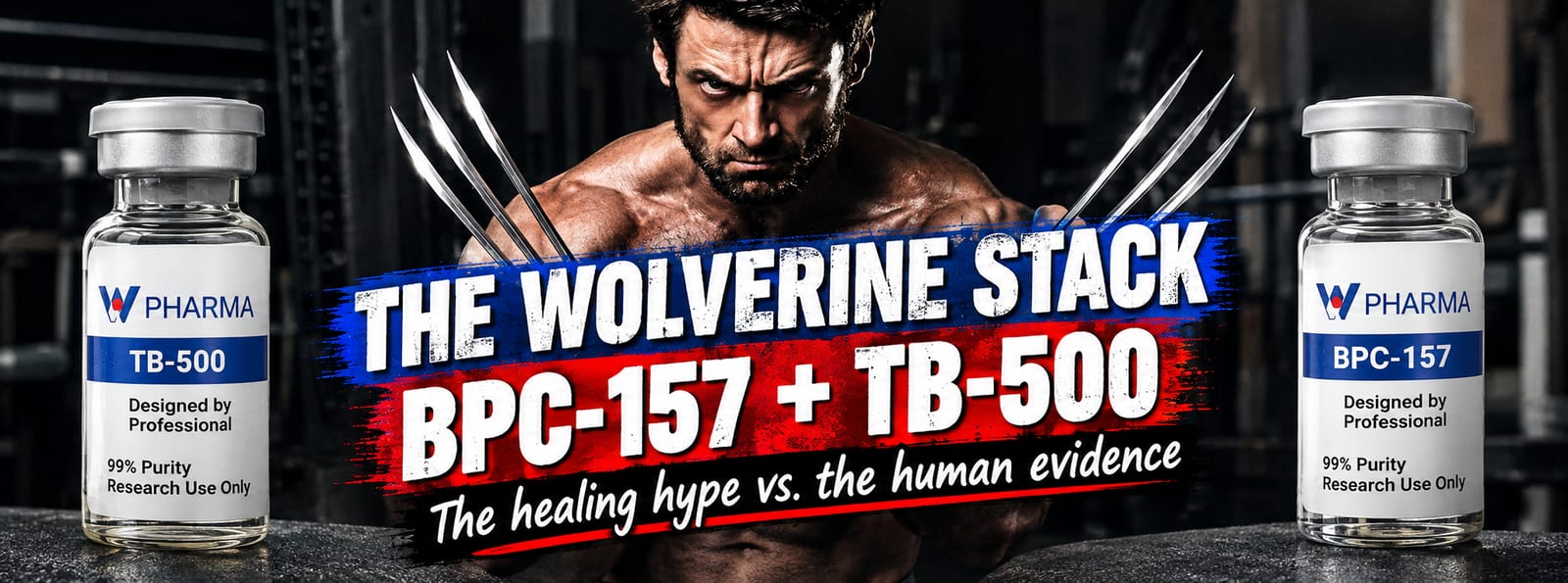
BPC-157 vs TB-500: which healing peptide for tendons, joints and recovery? Mechanism, dosing, evidence and the stack that actually settles the debate.
BPC-157 vs TB-500 is the great peptide debate. Which one for tendons, joints, gut and recovery — mechanism by mechanism, evidence by evidence, ending in the only stack that actually works.
Ask the internet which healing peptide is better and you'll get a bar fight. The BPC-157 crowd says BPC is the only one that matters. The TB-500 crowd says BPC can't touch thymosin beta-4's mechanism. Both sides have stories, none of them have clinical trials, and meanwhile you're sitting with a cranky elbow wondering which vial goes in the drawer.
Here's the uncomfortable truth neither camp wants to admit: BPC-157 and TB-500 are different tools doing different jobs, and the argument is mostly about which tool the arguer likes to hold.
So let's settle it properly. Mechanism, evidence, dosing, practical use — and the honest answer for the guy asking which single peptide to buy. Spoiler: the answer he usually needs isn't "one of them."
The Two Molecules
BPC-157 is a synthetic pentadecapeptide — fifteen amino acids derived from a protein in your stomach lining. Its origin story is gut protection; bodybuilders adopted it for tendons and joints. It's the generalist: one drug, many repair pathways, a legendary fan club.
TB-500 is an active fragment of thymosin beta-4 — a naturally occurring human protein with a known, traceable role in cell migration and tissue repair. It's the specialist: built around the actin-binding domain that makes it a connective tissue repair worker.
Right away the difference matters. BPC comes from a wound-healing protein of the gut. TB-500 is a fragment of a protein your body already uses to repair tissue. Both sound plausible; both live in research-grade territory with a rodent-heavy evidence base.
Mechanism: How Each Actually Works
- BPC-157 works through a broad cascade: nitric oxide modulation, angiogenesis (new blood vessel growth), collagen synthesis, growth factor VEGF, IGF-1), and protection of the gastrointestinal lining. It's a shotgun — multiple pathways, various effects, centered on accelerated tissue repair.
- TB-500 works through a specific actin mechanism: it binds and sequesters G-actin to regulate the cytoskeleton, promoting cell migration into damaged tissue, plus angiogenesis and anti-inflammatory modulation, with an emphasis on collagen deposition where connective tissue is being rebuilt. It's a rifle — one well-characterized mechanism aimed at the tissue that heals slowest.
The practical translation: BPC is the broad-spectrum repair agent that also fixes your stomach. TB-500 is the tendon specialist. That single distinction drives most of the "which is better" answers — it's why the guy with gut issues and the guy with a torn rotator cuff aren't disagreeing about the same drug.
Evidence: The Honest Table
| Aspect | BPC-157 | TB-500 |
|---|
| Origin | Stomach protein derivative | Thymosin beta-4 fragment |
| Mechanism | Broad: NO, angiogenesis, collagen, gut lining | Specific: actin regulation, cell migration |
| Tendon/ligament evidence | Strong animal data | Strong animal data |
| Gut healing evidence | Best-documented (original use) | Limited |
| Human athletic trials | None | None |
| Community consensus | Deep and enthusiastic | Deep and enthusiastic |
| FDA approval for humans | No | No |
Neither wins on clean clinical evidence because neither has any human trials for athletic recovery. This is two research chemicals with different mechanisms, both judged by the same hill of rodent studies and gym-floor legend. The honest move is to pick by mechanism fit, not by which forum thread screamed louder.
Dosing: The Practical Comparison
| Protocol | BPC-157 | TB-500 |
|---|
| Standard daily dose | 250–500mcg | 2–2.5mg |
| Typical frequency | 1–2× daily | 1–2× weekly |
| Cycle length | 4–8 weeks | 6–12 weeks |
| Injection | SubQ near site or belly | SubQ or IM, systemic preference |
| Half-life handling | Stable, forgiving | Short, needs frequent dosing |
The dosing difference is the biggest practical shock for new users. BPC is a daily microdose — you're pinning every day, staying consistent. TB-500 is a twice-a-week loading protocol with a longer total window. One hurts your injection-site rotation, the other hurts your reconstitution math.
Which One Should You Pick?
Stop asking "which is better" and start asking "what am I treating."
The shortcut table:
| Injury / goal | Better starting pick | Why |
|---|
| Patellar tendinopathy / jumper's knee | TB-500 | Connective tissue specialist, targeted tendon repair story |
| Chronic elbow (tennis/golfer's elbow) | TB-500 or the stack | Tendon heavy; if gut issues also present, add BPC |
| Achilles tendinopathy | The stack | Both mechanisms, tendon + general recovery |
| Rotator cuff / shoulder | The stack | Mixed tissue, both repair pathways |
| Gut issues (IBD-like, leaky gut) | BPC-157 | BPC is the only one with a real GI-protection mechanism |
| Muscle strain / tear recovery | BPC-157 | Broad repair, daily dosing suits the acute window |
| Post-surgical connective tissue | The stack | Full toolbox for serious rebuilding |
| Prehab on a heavy volume block | BPC-157 or low-dose both | General protection while workload climbs |
That table isn't dogma — it's a map. The people who actually fix injuries with peptides pick by tissue type, not by brand loyalty, and the ones who heal fastest are the ones who treat the drug as part of a program, not as the program.
Choose BPC-157 if:
- You have gut issues alongside recovery problems — BPC is the only one with a real gut-healing mechanism.
- You want the broadest effect on the most tissue types with one compound.
- You don't mind a daily pin and want the most flexible, forgiving protocol.
Choose TB-500 if:
- The problem is specifically a tendon or ligament — patellar tendinopathy, chronic Achilles, elbow tendinosis.
- You're treating connective tissue that isn't resolving with rest and rehabilitation.
- You want the compound with the most targeted, mechanistically specific repair story.
Run both if:
- You have a serious, chronic, or post-surgical connective tissue injury and you want the full toolbox.
- You're a high-volume lifter doing a healing/prehab phase and want to protect the joint and tendon workload.
The "BPC-157 plus TB-500" stack isn't bro-logic — it's the immune system's own strategy of pairing broad repair (BPC) with structural restructuring (TB-500). It's the most common protocol in the peptide underground for a reason. Our TB-500 guide and BPC-157 bible have the full protocols for both, and the GH-RH & Peptides category covers the wider catalog.
The Part Everyone Forget
Neither peptide fixes a broken movement pattern. If your elbow hurts because you bench with your elbows flared and your recovery is garbage because you sleep 5 hours and eat like a raccoon, BPC-157 and TB-500 are both expensive accessories to a self-inflicted problem.
- The healing stack works best on a solid foundation: real sleep, real food, real programming.
- Pair it with MK-677 and CJC-1295/Ipamorelin if you want the full recovery environment, not just the repair workers.
- And if you're injured on cycle, remember the first cycle guide wisdom: gear doesn't fix tendons; healing peptides support the process that does.
The Full Healing Environment
Here's the part the vendor pages rarely get to, because it doesn't sell vials: the two peptides are the repair crew, but they're not the construction site. For a damaged tendon or an overworked joint, the peptide only works if the environment around it is doing its job.
- Sleep is the anabolic window where the repair actually lands. No peptide compensates for chronic sleep debt; half of the injuries in this niche are just over-training plus under-sleeping wearing out a tendon that never gets its repair shift.
- Calories and protein matter more than the vial. Damaged connective tissue needs building blocks. A cutting diet with no protein support is paying the repair crew while starving the construction site.
- Training load is the variable you control. The person who trains smart, deloads the injured area, and removes the aggravating pattern heals faster on less peptide than the person who trains the same broken way and doubles the dose.
- Blood flow beats most site-specific debates. The older "inject right on the injury" religion ignores that these peptides raised angiogenesis systemically in the research. Consistent dosing beats obsessive needle placement.
If you want the full recovery protocol without buying peptides blind, the BPC-157 bible and the TB-500 guide each lay out their own complete protocol, and the GH-RH & Peptides category is where the actual catalog lives.
Bottom Line: The Healing Stack, Settled
BPC-157 is the generalist; TB-500 is the specialist. For gut and broad tissue protection, BPC wins. For tendon and ligament repair, TB-500 has the cleaner story. For a real, chronic, or post-surgical injury, the answer isn't either/or — it's the stack, because the underlying biology uses both strategies.
The debate isn't about which peptide is better. It's about which job you're hiring for. Hire both for the big jobs, hire the specialist for the tendon, hire the generalist for the gut — and never hire either to fix the technique that caused the injury in the first place.
Real talk for people who pin: the best healing protocol in the world still loses to a half-assed training program and a broken sleep schedule.
Keep Reading
The Gear