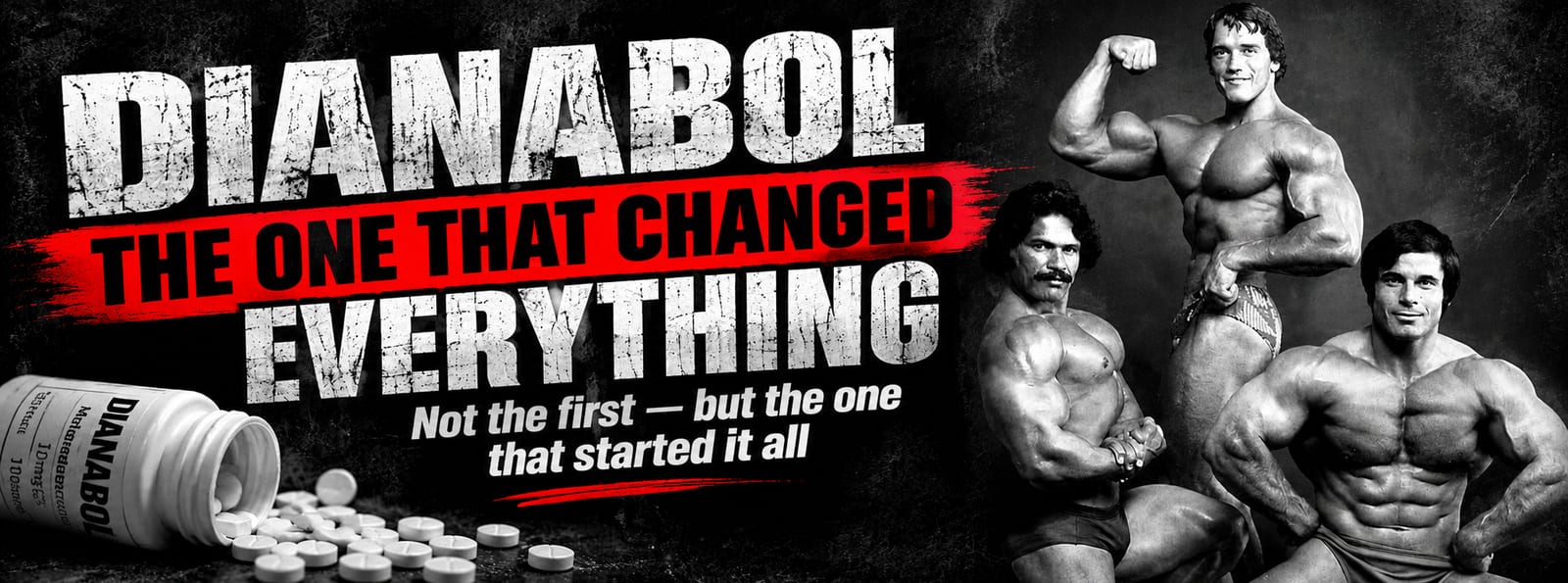
Dianabol history from the 1954 Vienna weightlifting hall and Ciba to the golden era physiques of Arnold, Frank Zane, Franco Columbu and Serge Nubret - and…
Most anabolic steroids have a clinical origin story. Dianabol has a Cold War one.
It begins in a Vienna weightlifting hall in 1954, involves a doctor who spent the rest of his life trying to hide his fingerprints on the sport, and reaches its strangest chapter in the 1960s, when the United States government effectively told the biggest men in the world that the pills they were swallowing by the handful were nothing but sugar pills.
This is the story of how one tablet helped build the most famous physiques in history, how the establishment insisted it couldn't possibly work, and how a law was finally passed that admitted, in writing, that the establishment had been wrong.
Chapter 1 - The Hunt for a Better Testosterone
Dianabol is the trade name of methandrostenolone, synthesized for the Swiss pharmaceutical giant CIBA in the mid-1950s. The project wasn't born in a lab of performance science. It was born at the 1954 World Weightlifting Championships in Vienna, where a young American team physician named Dr. John Bosley Ziegler made a discovery that unsettled him.
The American lifters noticed the Soviet team was enormous and intimidating. More importantly, Ziegler picked up an anecdote that the Soviets were not relying on training alone. The story he brought home, contested for its details but repeated for decades, was that Soviet athletes were using injectable testosterone to build strength beyond what training could deliver.
Ziegler was alarmed but curious. If Soviet athletes could get an edge from hormone manipulation, American athletes would need one too, or lose. Rather than copy the Soviet approach, his idea was to build something safer: a weak, oral, easily-dosed anabolic compound that produced the muscle-building effects with fewer of the aggressive androgenic side effects of raw testosterone.
Working with CIBA, Ziegler helped shape methandrostenolone, a 17-alpha-alkylated oral steroid with modest androgenic character but strong nitrogen-retention and protein-synthesis properties. In 1958, the FDA approved Dianabol for prescription use. It became the first widely-available anabolic steroid in the United States.
At the time, its marketing leaned on therapeutic benefits: recovery from surgery, osteoporosis, weight loss in the wasting. But the men who sought it out had other plans. Within a few years of its 1958 release, Dianabol was the unofficial training fuel of American weightlifting, powerlifting, and early bodybuilding.
Chapter 2 - The Golden Era Machine
To understand what Dianabol did to the sport, you have to understand what the training world looked like in 1958. Bodybuilding was a subculture built in garages and YMCA gyms. Nutrition science as we know it barely existed. The idea of eating measured grams of protein, tracking hormones, running bloodwork, none of it was on the horizon.
Into that vacuum dropped a tablet that made the body respond to training with almost unreasonable generosity. Gains on Dianabol weren't gradual. Lifters reported adding bodyweight and strength in weeks, not years. And because it came in a small pill, easy to carry, easy to swallow at the training table, it spread like nothing before it.
This is where the mythology begins. Hearing golden-era athletes describe their training years, you'll encounter the recurring image: pills being handled at meals "like M&Ms." It's a retrospective image, told by men in their fifties and sixties remembering their twenties, not a documented daily routine, but it captures the era's casualness. There was no protocol, no PCT, no written cycle. There was a bottle, a meal, and an instinct that more was better.
Diet culture grew to match. Arnold Schwarzenegger and his contemporaries trained at Gold's Gym in Santa Monica and ate with the same aggression they brought to the squat rack. The Dianabol era didn't just change how men looked. It changed what men believed was possible from a body. Sanctioned bodybuilding in the 1960s and 1970s was being built on top of a medicine cabinet.
Chapter 3 - The Physiques It Built
It's dishonest to say any single compound "made" an individual. Genetics, years of brutal training, and obsessive diet made these men. But the chemical substrate is part of the record, and several of the sport's greatest physiques were explicitly built in the Dianabol era.
Arnold Schwarzenegger, the most famous bodybuilder in history, trained in the late 1960s and early 1970s, precisely the peak of Dianabol's informal dominance. Arnold was famously evasive about exact compounds for decades, warming up in athletic-sounding explanations; in Pumping Iron (1977) he delivered his famous speech about the importance of achieving the ultimate look. He only became genuinely open about his earlier drug use in his autobiography Total Recall (2012). His retrospective accounts place his physiques squarely in a generation powered by oral anabolic use that included Dianabol-era compounds.
Frank Zane, three-time Mr. Olympia and the master of aesthetic proportion, remains a case study in how much could be achieved with comparatively lighter compound loads combined with obsessive, training-focused rigor. Zane's physique was celebrated because it did not have the mass monsters' bulk; his era was a bridge between the size era and the controlled-craft era.
Franco Columbu, Arnold's training partner and rival, Mr. Olympia twice, a former boxer whose power and structure were built in the same Santa Monica gyms on the same chemical foundation.
Serge Nubret, the French bodybuilder whose carved, almost sculptural musculature made him one of the most referenced physiques of the 1970s. Nubret belonged to the generation where this chemistry was, in the words of participants, simply part of the culture.
The names that dominate gym posters today, Schwarzenegger, Zane, Columbu, Nubret, and the competitors alongside them, were products of the first era in which an entire top-tier sport ran on one widely-dispensed chemical tool.
That era also set a cultural standard that never really left. Look at how modern bodybuilding is judged: mass first, conditioning second, symmetry third. That ordering is a direct inheritance from the Dianabol years, when the fastest route to "who is that guy" was visible size, and when the mirror rewards of a full pump made big-and-full the house style. The physiques the pill helped produce became the benchmark every later generation measured itself against, whether consciously or not.
Chapter 4 - The Government's "It Doesn't Work" Episode
Now we arrive at the strangest part of the story.
By the mid-1960s, the FDA, congressional committees, and organized medicine had begun to notice that a prescription drug meant for convalescents was being consumed by enormous athletes. There were hearings. There were press conferences. And there were reports and statements, some issued by credible institutions, telling the American public that anabolic steroids "do not enhance athletic performance."
The claim was part-methodological and part-agenda. Clinical trials available at the time were small and inconclusive. Testimony leaned on the idea that there was "no scientific evidence" of performance benefit. Sports officials, eager to keep the Olympic movement clean in the age of early doping scares, repeated the line. If the drugs didn't work, there was nothing to police.
The bodybuilding community heard this differently. Men who had trained, eaten, and taken the tablets had felt the difference. To the athlete holding twenty pounds of new bodyweight, the official "it does nothing" declarations read less as science and more as a green light. The natural conclusion, and the era's folklore, was: if the government says it's useless, it's obviously safe enough to take in bulk. Reported accounts of the time describe top competitors treating the denial as a license, not a warning.
It is one of the great ironies of sports pharmacology history: the establishment's attempt to dismiss the drug's value inadvertently helped normalize its use. The pill the government kept calling ineffective was the pill being swallowed at every meal by the biggest men in the sport. Both things were widely known at the same time.
Chapter 5 - The Chemical Cousins and the Origins of "Bro-Science"
One more inheritance from the Dianabol era deserves its own line: the birth of what bodybuilders later called bro-science. Before the pill, "dosing" discussion in lifting circles was about sets, reps, and eggs. After it, generic gym conversations suddenly revolved around milligrams, half-lives, and who knew a guy at the pharmacy. Dianabol didn't just build physiques. It built the conversational culture of the gym — the exact language of stacks, orals, and cycles that every modern forum, podcast, and guide still speaks in.
That language carried an edge too. The same casualness that let an era eat pills "like M&Ms" is the same casualness that produced its horror stories. Every modern caution about bloodwork, estrogen management, and liver enzymes exists precisely because the golden era proved what unmanaged use costs. The culture the pill created eventually had to grow up — and the growth happened in the form of guardrails the pioneers never had.
Chapter 6 - The Reckoning
The culture couldn't stay unchecked forever. By the late 1960s and into the 1970s, side effects became impossible to ignore: hair loss, estrogen-related water retention and gynecomastia from unmanaged aromatization, blood-pressure concerns, the liver-stress warnings attached to its oral 17-alpha-alkylated design, and the shutdown of natural testosterone. Labs began reporting dramatic hormonal profiles in athletes. Doctors started changing their narratives.
The sport's own great ironist is Dr. Ziegler himself. In his later years he reportedly told a Rome newspaper and various interviewers that he regretted creating the compound, that it became something he "wished he had never" produced. He watched the genie he helped uncork escape completely. Ziegler died in 1983, having never fully left the steroid era's gravitational pull, publicly apologetic, privately legendary, and permanently tied to the tablet that changed his sport.
By the 1980s, the medical establishment's earlier claims were looking increasingly indefensible. The evidence, the athletes' experience, and simple observation had all converged on the obvious conclusion: the drugs worked, too well. Olympic scandals, the 1988 Ben Johnson affair, and growing public concern pushed the issue to Congress. The era of "it doesn't work" was over; the era of panic had begun.
Chapter 7 - The Law That Admitted the Obvious
The final punchline arrived in the Anabolic Steroids Control Act of 1990.
When the U.S. placed Dianabol, Deca-Durabolin, Primobolan, and the rest into the Controlled Substances Act in November 1990, it wasn't a routine scheduling. Congress wrote legislative findings, and those findings said, in sworn federal statute, exactly what the 1960s establishment had spent years denying.
The 1990 Act's findings declared that anabolic steroids "are taken by short-term and long-term users to enhance athletic performance and physique," and went further, describing a "glass ceiling" that users cannot break without chemical assistance. Thirty years earlier, the official line had been that these pills did nothing at all. Now the law of the land formally acknowledged they did so much that the government had to ban them to protect sports and competitors.
The arc is complete: from a Cold War rivalry, to a "miracle" pill, to an era of official denial, to a golden age of physiques built on it, to a reckoning, and finally to a law that said what everyone in the gym had always known.
Why This History Matters Today
Dianabol is not a curiosity muttered about by historians. It is a direct ancestor of nearly every bodybuilding practice of the modern era: the first widely-used oral anabolic, the template for cycle thinking, the reason "the golden era" looks the way it does, and a case study in how official claims and athletic reality can diverge for decades.
For the serious bodybuilder, the lesson isn't nostalgia. It's context.
- The legendary physiques were built with ruthless training, discipline, and diet, plus chemistry. The chemistry amplified the work; it never replaced it. Arnold trained for hours every day. Zane built a training manual out of careful programming. Nubret's artistry was decades in the making. The pill was an amplifier, never the source.
- The "government said it didn't work" era is a cautionary tale about trust: who you believe about performance, and why institutions can be behind the curve for a generation.
- The golden era was also the era of zero protocol: no bloodwork, no estrogen management, no PCT culture. The men paid for that carelessness, often with their health. The modern lifter's advantage is knowledge, not just compounds.
Dianabol built an era. The era built legends. And the legends' archives still hang on gym walls today, a permanent reminder of what one small tablet, a Cold War, and a generation of fearless lifters did to the sport of bodybuilding.
Historical and educational overview. This article covers documented history and context and is not medical authorization, a dosing guide, or an endorsement of use. Anabolic steroids are controlled substances in many jurisdictions; any decision about them belongs between you and qualified medical professionals.