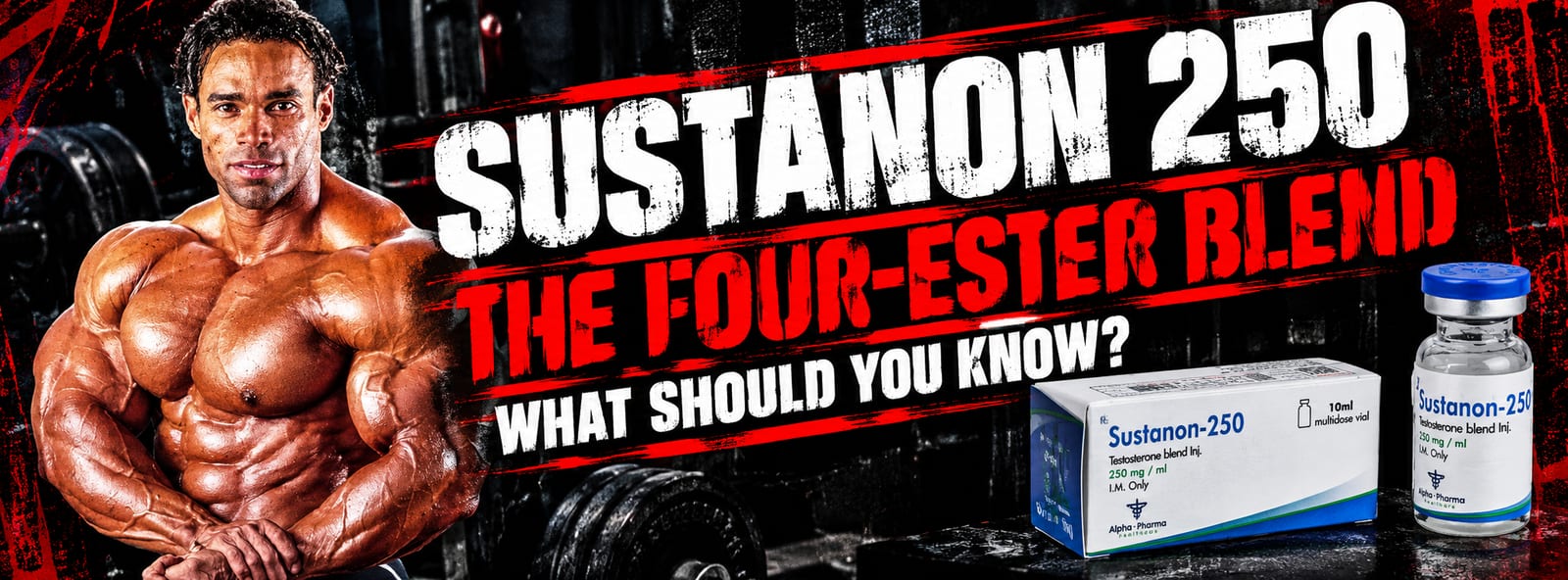
Sustanon 250 buying guide: the four-ester ampoule, what a legit listing looks like, red flags, and the dosing reality of a blended testosterone.
Sustanon 250 is the blended testosterone — four esters in one 250 mg/ml shot, beloved by old-school bodybuilders and counterfeited by everyone else. It still carries the classic pharmacy-ampoule look, and that is exactly what scammers replicate best. Buying sustanon online is not shopping; it is authentication. Here is how to read a listing, what the legit article actually looks like, and how to order the right amount the first time.
What Sustanon 250 Actually Is
One milliliter, 250 mg of total testosterone, split across four esters: propionate (30 mg), phenylpropionate (60 mg), isocaproate (60 mg), and decanoate (100 mg). The short esters hit in the first days; the long tail carries the week. That blend is the whole point of sustanon and the whole reason it gets faked — the label is easy to print and the chemistry is harder to argue with from a photo.
Know what you are buying before you compare prices: sustanon is testosterone. It is not a stronger test, a faster test, or a "stack in a bottle." If a seller markets it as anything beyond that, you are already talking to the wrong seller.
What Real Sustanon Looks Like
- Glass ampoule (the classic presentation) or a modern multi-dose UGL vial labeled Sustanon 250 at 250 mg/ml
- Clear, slightly golden oil with nothing floating in it — no milkiness, no chunks, no shower-glass film
- The ampoule neck is cleanly scored and snapped, not chipped; the print on the glass is crisp, not pixelated or smudged
- Box, ampoule, and insert carry the same batch number, printed identically — mismatched batch codes are the fastest tell in the aisle
- Sealed cartons of 10 amps are the classic pharma unit; a flood of "single sealed amps" from ten different sellers should make you suspicious of the whole batch
The Two Worlds of Sustanon Buying
You will meet two types of listing. The pharma-grade ampoule is the classic Organon-style presentation — and today it is the most counterfeited glass in the game, because the look carries trust and fakers know it. A pristine box with sloppy print is the standard costume.
The modern UGL vial is simpler to evaluate: a 10 ml vial at 250 mg/mL from a lab with years of batch history and photos you can reverse-search. For a first-time buyer, a reputed UGL vial beats a fake-ampoule minefield every time. Whichever world you enter, demand the same proof: batch-matched test, consistent printing, and a seller who answers ester questions without deflecting.
Red Flags in Listings
- No batch number printed consistently across the batch photo — or worse, the same photo reused for five different products
- Price drastically under a comparable test enanthate order — blended test is not cheaper to make; four esters cost more, not less
- Stock photo of "Sustanon 250" with no in-hand proof, no date stamp, no batch
- Sellers who cannot tell you the ester blend. If they do not know what is in it, neither do you — and the label is the only thing you are buying
- Batch numbers that return nothing on the lab's verification page
Dosing Reality Before You Order
Sustanon's varied esters mean blood levels wave a little more than plain enanthate, which is why experienced users pin it twice a week anyway — the short esters demand it. Know that before buying: you are paying a premium for heritage, and the result is testosterone, no more and no less. That keeps expectations honest when the parcel lands.
Arrival check: the ester list on the label matches the box, the batch number prints identically across box and ampoule, and the oil runs clear to golden with nothing floating in it. Organon-style glass gets copied daily — the batch number is your witness.
Common Sustanon Scam Patterns
- The organon cosplay: counterfeiters print classic box art with sloppy registration — blurred ampoule text, wrong batch font, inserts on paper that feels like tissue. The nostalgia is the hook; check the print
- The ester dodge: sellers who answer "what is in it" with "it is sustanon, bro." The four esters and their milligrams should roll off their tongue — that is the product
- The single-amp flood: loose "sealed" amps with no box, no insert, no matching batch. Classic sign of a batch split across twenty resellers who cannot show you the source
- The premium markup on heritage: sustanon priced far above identical test enanthate because of the Organon story. Pay a little more for a verifiable blend — not double for a name
Ampoule vs Vial: The Practical Verdict
Ampoules force the full dose at once and demand a clean snap every time — open them with an ampoule file, wipe the neck, and never let a glass shard float into the oil. Vials let you draw exactly what the schedule calls for and keep the rest sealed. For a first-time buyer, the vial from a lab with batch history wins on verifiability alone: you can photograph the batch, match it to the posted test, and store the remainder without opening glass you cannot reseal.
If you do buy amps — for the heritage, the ritual, or the collectible box — verify the batch across carton, ampoule, and insert before the first snap, and keep one unopened amp from the batch as your reference sample. It costs one shot of storage and it gives you proof if the rest of the batch ever gets questioned.
Bloodwork and Sustanon: What to Expect
Because sustanon is testosterone, its bloodwork story is the testosterone story: total levels track your dose and pin frequency, hematocrit climbs with the dose, lipids and natural testosterone suppression follow the standard arc. What matters for you as a buyer is the stability angle — the four-ester blend is supposed to smooth the ride, and honest bloodwork shows it. Levels that swing wildly between pins suggest either a bad injection schedule or a product whose ester profile does not match its label.
That is the quiet verification most people skip: run the cycle as planned, get mid-cycle bloods, and look at where your total testosterone actually sits relative to the dose you pinned. Real 250 mg/mL product at 500 mg a week puts most men squarely in the supraphysiological range by week six. A product that leaves you barely above baseline at the same dose was underdosed — no argument, no forum opinion, just the number. Baseline draw before the first pin, mid-cycle draw around week six, and the truth about your vial.
Order Sizing (Do the Math First)
Sustanon 250 at a normal 250–500 mg weekly range means one 10 ml vial covers roughly 5–10 weeks depending on dose. Plan the full cycle before checkout: a standard 12-week testosterone cycle needs 3–6 ml total, so a single vial with a margin, or two vials for a longer or higher-dose run. Mid-cycle restocks are how people end up switching labs halfway through a blood draw — buy the run in one batch and keep the batch number.
Sustanon Buying FAQ
- Is sustanon better than test enanthate? No — it is the same hormone with a different ester blend. You pay for heritage and get testosterone. Enanthate is simpler to pin and easier to verify
- How often should sustanon be pinned? Twice a week, regardless of the decanoate in the blend — the propionate and phenylpropionate halves demand it for stable levels
- Ampoules or vials? Vials from a lab with batch history are easier to verify. Classic ampoule glass today is the most counterfeited presentation in testosterone
- What should real sustanon oil look like? Clear to light golden, nothing floating, no cloudiness. Anything milky or particulate gets quarantined, not injected
- How much do I order for one cycle? A 12-week cycle at 250–500 mg a week is 3–6 ml — one 10 ml vial covers it with margin. Order the full cycle in a single batch
The Bottom Line
Buy sustanon only with batch-proof and a lab identity you can verify. Prefer a reputed UGL vial over mystery ampoules, respect the 250 mg per ml math, keep the pin schedule at twice a week for smooth levels, and size the order for the whole cycle before you pay.
The Fine Print
This is educational content, not medical advice, and not an instruction to use any compound. Anabolic-androgenic steroids, growth hormone, insulin, and related performance drugs are controlled substances in most jurisdictions, are not approved for human use, and carry serious cardiovascular, hormonal, psychiatric, and legal risks. Talk to a licensed doctor, run real blood work, follow your local laws, and — if you compete — your sport's anti-doping rules. Nothing here is a prescription, and no outcome is guaranteed.
Content last reviewed: September 28, 2026 · NotNatty.cc is informational only and is not a substitute for professional care.

 Alpha Pharma