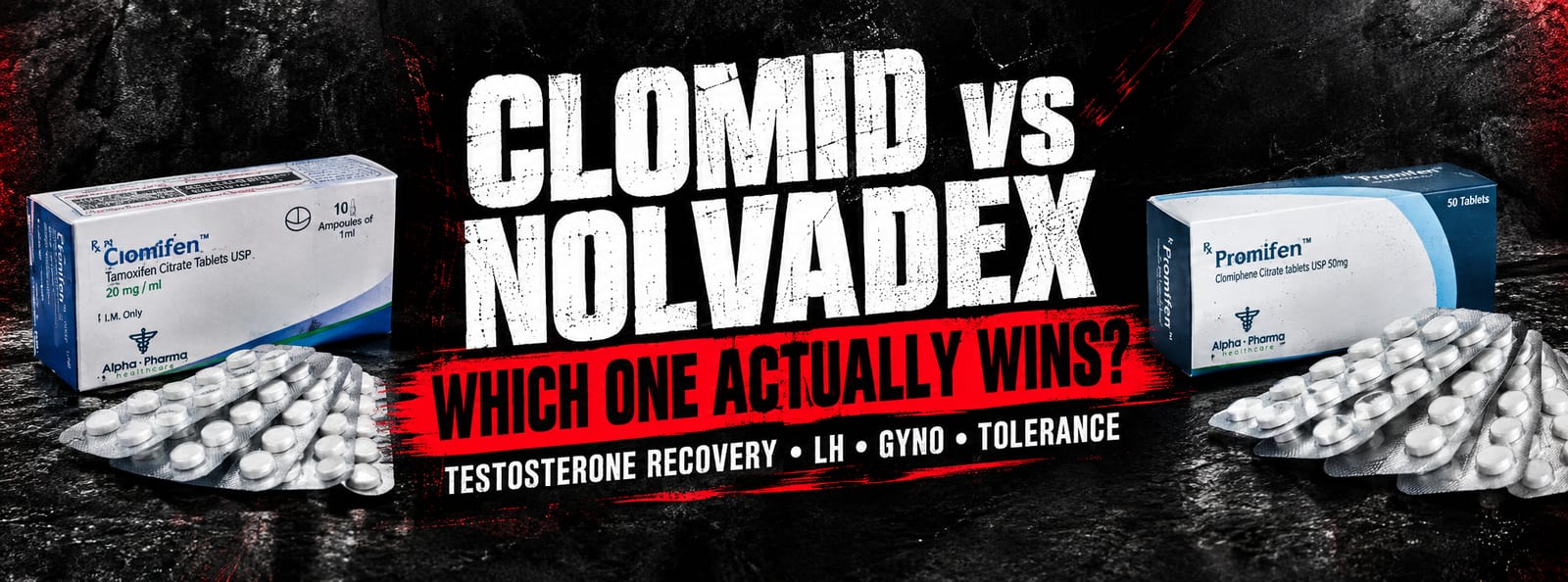
Clomid vs Nolvadex settled: both restart testosterone, clomid pushes LH harder, nolvadex wins on gyno and tolerance - the differences that matter and the ones that do not.
Both work. Clomid (clomiphene citrate) typically pushes LH and FSH harder, so it wins on pure testosterone restart, while nolvadex (tamoxifen) is generally better tolerated and is the go-to when gyno management is the priority. The real answer to "which SERM wins PCT" is the one you can tolerate for four weeks straight while your bloodwork climbs back to baseline. Everything else is forum tribalism.
What a SERM Actually Does (and What It Doesn't)
Clomid and nolvadex are both SERMs - selective estrogen receptor modulators. They do not remove estrogen from your body; they block estrogen's signal at the hypothalamus and pituitary. Fool that system into thinking estrogen is low, and it spits out more GnRH, then more luteinizing hormone and follicle-stimulating hormone, and those tell your testes to fire up testosterone production again.
Wiping out estrogen is a completely different job - that's what aromatase inhibitors do, and the two classes get confused constantly. If you want that side of the story, read arimidex vs aromasin for estrogen control, or the individual breakdowns of anastrozole and aromasin. Some estrogen on cycle is a feature, not a bug - crush it to zero and you lose libido, dry out your joints, and wreck your mood. PCT is about signal, not suppression.
Also worth knowing: SERMs are not blanket anti-estrogens. They block estrogen in some tissues and mimic it in others. That selectivity is why nolvadex helps gyno while clomid can produce estrogenic complaints despite being an anti-estrogen.
Clomid: The Stronger Restart
Clomid is the heavier hammer on the pituitary. Most users report a harder bounce in LH and FSH than an equivalent nolvadex run, which earned it the reputation as the pure testosterone-restart drug. If the single job is getting endogenous production moving after a suppressive cycle, clomid is the default pick in a lot of protocols.
The commonly reported community protocol is 50 mg per day, then a taper - the classic 50/50/25/25 pattern across roughly four weeks. Read that as a community-reported pattern, not a prescription. Doctors write their own schedules and order their own bloodwork.
One line on the chemistry: clomid is a mix of two isomers, and enclomiphene is the cleaner component doing most of the testosterone driving - which is why some guys go looking for enclomiphene by itself.
The catch is side effects. Clomid has a reputation for mood changes - irritability, flatness, the emotional range of a spreadsheet - and rare-but-noted visual complaints, usually described as floaters. Not everyone gets them, but it happens often enough to watch for. And because clomid acts as an estrogen agonist at some receptors, you can get estrogenic side effects while taking an anti-estrogen. Thrilling.
Nolvadex: The Tolerable Workhorse
Nolvadex drives the pituitary more gently than clomid for a lot of users, and that milder push comes with a milder side effect profile. The classic four-week community protocol is 40/40/20/20 - 40 mg daily for two weeks, then 20 mg daily for two. Same rule as before: a reported pattern, not a prescription.
Where nolvadex genuinely pulls ahead is gyno. Tamoxifen is well documented for gynecomastia management and reversal, and the anti-gyno practice of running 10-20 mg during a cycle when a lump starts forming is everywhere for a reason: it works often enough to become default advice. Start with how to get rid of gyno, then prevention strategy in how to prevent gyno on cycle. And no, a SERM is not an AI - if estrogen is high across the board, that is a job for an aromatase inhibitor.
Side Effects: Where They Actually Differ
- Clomid: stronger LH/FSH drive, a higher rate of mood complaints, rare reported visual changes, and agonist effects at estrogen receptors - bloating and nipple sensitivity show up in some users.
- Nolvadex: milder pituitary stimulation, generally better tolerated, with occasional hot flashes, leg cramps, or stomach upset. Neither drug is risk-free - both carry a clotting-risk profile worth respecting.
- Both: long half-lives measured in days, so once-daily dosing is standard, and both are prescription drugs in most countries.
Nobody settles a side-effect argument online. What matters is your response: guys who feel rotten on clomid switch to nolvadex and finish the block, guys who feel flat on nolvadex go the other way. Trial, not dogma.
Gyno Management vs Testosterone Restart: Choosing Your Weapon
Choose clomid when the goal is restart. Choose nolvadex when gyno is on the table or your mood will not tolerate clomid. Some community protocols run both at once, usually with clomid carrying the LH load while nolvadex handles receptor-level gyno control. There is no solid evidence you must combine them, and stacking SERMs doubles the chance you feel like garbage for no guaranteed payoff.
Zoom out: the gap between these two molecules matters far less than actually running PCT after a suppressive cycle. PCT exists to restart your own production after a cycle - the full framework is in PCT 101. And a SERM is not a hormone: it cannot replace testosterone as a base during the cycle itself. Holding your levels up while you run other compounds is covered in steroids without a testosterone base - short version, do not do it.
Still mapping out the cycle itself? The first steroid cycle guide comes before PCT threads. Oral-only setups like an anavar-only cycle suppress you too - the PCT conversation is identical.
Dosing, Timing, and How Long to Run It
Both drugs have half-lives measured in days - clomid roughly five to seven depending on the source, tamoxifen longer through its active metabolite - so once-daily dosing is the norm and splitting doses through the day buys you nothing. Exact numbers vary by source; either way, these are long-acting, not fast.
Start timing depends entirely on how long the ester takes to clear. Long esters linger for weeks after your last shot, and starting SERMs early means running them against suppression that is still in your blood - wasted weeks and wasted drug. Wait for clearance, then start. The timelines live in the detection times chart for half-life context and in the testosterone cypionate guide for a practical example of how long cyp hangs around.
How long should you run it? Standard community PCT is four weeks minimum, sometimes five to six after heavier or longer cycles. Longer is not automatically better - extended SERM runs pile up side effects without proportional benefit for most guys. Get bloodwork at the end. Total testosterone plus LH and FSH four to six weeks after PCT finishes tells you more than a thousand forum arguments ever will.
If bloodwork still shows you shut down at 300 ng/dL months later, no extra SERM fixes that - that is a TRT conversation, covered honestly in TRT vs underground testosterone. And if someone is pushing Proviron as a PCT helper, it is mild at best and it is not a SERM - see the proviron guide for what it actually does.
The Bottom Line
Clomid and nolvadex restart testosterone through the same mechanism, and neither is the universal winner. Clomid hits the pituitary harder and wins on raw restart. Nolvadex is easier to live with and wins on gyno. Pick the SERM you will actually finish, run it for roughly four weeks after your esters have cleared, and let bloodwork - not forum consensus - decide your next PCT.
Clomid vs Nolvadex PCT FAQ
- Which is better for PCT, clomid or nolvadex? Clomid pushes LH and FSH harder, giving it the edge on pure restart, while nolvadex is better tolerated and stronger for gyno. The better drug is the one you finish and that gets your bloods back to baseline.
- Can you take clomid and nolvadex together? Some community protocols combine them - clomid carrying the LH load, nolvadex handling gyno control at the receptor level. There is no hard evidence you must stack them, and doubling SERMs doubles your side effect risk.
- Does nolvadex boost testosterone? Indirectly, yes. By blocking estrogen at the pituitary it raises LH and FSH, which signals your testes to produce more of your own testosterone. It does not add testosterone to your body the way an injection does.
- How long should PCT last? About four weeks minimum, sometimes five to six after heavier cycles - the 50/50/25/25 clomid and 40/40/20/20 nolvadex taper patterns are the most reported. Bloodwork at the end matters more than the exact day count.
- Do clomid and nolvadex cause side effects? Yes. Clomid is more associated with mood changes and rare visual complaints like floaters; nolvadex is usually better tolerated but can cause hot flashes, cramps, or stomach upset. Both carry real risk profiles as prescription drugs.
The Fine Print
This is educational content, not medical advice, and not an instruction to use any compound. Anabolic-androgenic steroids, growth hormone, insulin, and related performance drugs are controlled substances in most jurisdictions, are not approved for human use, and carry serious cardiovascular, hormonal, psychiatric, and legal risks. Talk to a licensed doctor, run real blood work, follow your local laws, and — if you compete — your sport's anti-doping rules. Nothing here is a prescription, and no outcome is guaranteed.
Content last reviewed: September 29, 2026 · NotNatty.cc is informational only and is not a substitute for professional care.

 Alpha Pharma