

Did Arnold Schwarzenegger Use Trenbolone for His 1980 Mr. Olympia Comeback?
Did Arnold use trenbolone before his controversial 1980 Mr. Olympia return? Explore the claims, bodybuilding history, steroid speculation, and what the evidence actually tells us.
Iron Scholar
November 20, 2026 · 6 min read
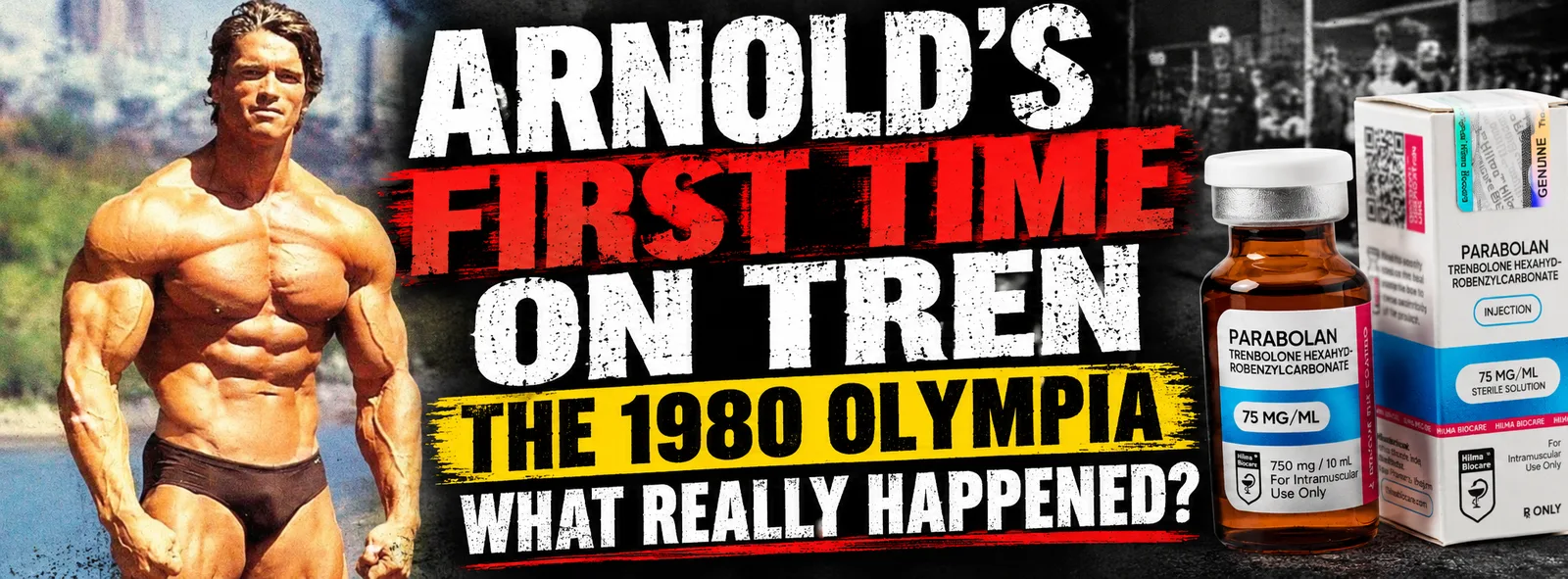
Here’s Why the 1980 Mr Olympia Still Divides Bodybuilding
October 4, 1980. Sydney Opera House.
Arnold Schwarzenegger had been out of competitive bodybuilding for five years. Hollywood was calling. Conan the Barbarian was on the horizon. Most people assumed the six-time Mr. Olympia was done. Then, roughly 24 hours before the show, he entered.
Eight weeks of serious training. That was the official story. He had been training hard for the film role, pushing from the mid-210s toward the 230 range, telling people the movie needed a more muscular look. The closer the Olympia got, the more the idea of competing took hold. He decided it would be “an interesting challenge” to do in eight weeks what most of the other men had spent a year preparing for.
The other competitors were not amused.
Frank Zane was the three-time defending champion, still recovering from a serious injury earlier that year and lighter than his best. Mike Mentzer, Boyer Coe, and Chris Dickerson were in outstanding condition. Mentzer in particular was considered a real threat. When Arnold announced he was competing, tensions exploded. There was a heated pre-contest meeting. Mentzer and Arnold nearly came to blows after Arnold needled him about his midsection. Joe Weider had to intervene. Arnold ultimately withdrew his push to reinstate weight classes and the show went on as an open contest.
On stage, Arnold was not the 1974 or 1975 version of himself. The upper body still carried the classic lines and presence. The legs were thinner. Some reports mentioned a cortisone shot for a shoulder issue that caused temporary water retention; he spent the night before the show posing hard under heat to try to flush it. He compensated the way Arnold always did — with charisma, posing control, stagecraft, and the ability to make judges look at him instead of the rest of the lineup.
When the scores were read, Arnold took first with 300 points. Chris Dickerson was second at 292. Frank Zane third at 291. Boyer Coe and Mike Mentzer tied on points but Mentzer was placed fifth. Roughly 40 percent of the audience booed. Dickerson left the stage saying he couldn’t believe it. Zane was later said to have thrown (or dropped) his trophy backstage. Mentzer was furious and never competed again. Several top names publicly talked about boycotting the 1981 show. CBS, which had been set to broadcast the event, never aired the footage.
That is the documented history of the 1980 Mr. Olympia. It remains the most argued contest in the sport’s history because it mixed a genuine last-minute comeback, visible physical limitations, personal relationships between Arnold and several judges (Reg Park, Albert Busek, and others had long ties to him), and the simple fact that bodybuilding judging is subjective and politics have always existed in the IFBB.
The Rapid-Prep Question
The short preparation window is the detail that keeps people talking decades later. Eight weeks is not a normal Olympia peak. Most men in that era still spent the better part of a year building and then cutting. Arnold himself framed it as a challenge precisely because the timeline was compressed.
This is where the pharmacology rumors enter. Gym lore and certain forum threads have long claimed that Arnold used trenbolone for the first time during this preparation, and that the compound’s rapid hardening and nutrient-partitioning effects helped him get contest-ready in a fraction of the usual time. Trenbolone acetate (sold as Finajet/Finaject for veterinary use) was available by the late 1970s and began circulating more widely among bodybuilders in the early 1980s. Its reputation for producing dry, dense tissue with relatively short exposure made it an attractive story for anyone trying to explain how a retired, Hollywood-focused Arnold could walk into the Opera House looking as good as he did.
Here is the no-BS version: Arnold has never confirmed trenbolone use. In later interviews he has been specific about the compounds he used during his competitive years — primarily testosterone (around 100 mg per week) and Dianabol (15 mg per day). Those were the two drugs he named when pressed for details decades later. Contemporary accounts and reconstructions of Golden Era cycles consistently list Dianabol, testosterone, Deca, Primobolan, and occasional orals like Winstrol or Anavar. Trenbolone does not appear in Arnold’s own disclosures or in the better-sourced historical summaries of his era.
Trenbolone’s popularity among bodybuilders rose after 1980. The compound’s strong androgenic and anabolic profile, low water retention, and ability to improve nutrient partitioning are real pharmacological properties. It is entirely plausible that some athletes of the period experimented with veterinary Finajet. It is also entirely possible that the “Arnold used tren for the 1980 comeback” claim is retrospective pattern-matching: short prep + hardened look + later knowledge of what tren can do = convenient narrative. Forum speculation is not primary evidence. Appearance alone never proves exact compounds or doses.
What is not speculative is that Arnold was enhanced. He has been open about steroid use for decades. The doses he has described are modest by modern professional standards. The 1980 physique was not his peak. It was still better, on the night, than most of the men standing next to him according to the judges who voted. Whether those judges were influenced by history, friendship, or pure visual assessment is the part that will never be settled with laboratory certainty.
Why the Night Still Matters
The 1980 Olympia is more than a controversy scoreboard. It marked the end of Arnold’s competitive career and the beginning of a different era in the sport. Mentzer’s retirement, the subsequent boycotts, and the lingering bitterness changed how some athletes viewed the IFBB’s power structure. It also demonstrated something that remains true: charisma, structure, and stage presence can still outweigh pure muscular density on a given night, especially when the judging criteria are not purely objective.
Arnold left bodybuilding with seven titles. He went on to become a global movie star and later a governor. The men who felt robbed that night largely faded from the spotlight or carried the grievance for years. The photographs and the limited video that exist still get dissected every few months on forums. Some people look at 1980 Arnold and see a legitimate winner who beat the field in front of him. Others see a political decision that devalued the efforts of men who had prepared for a full year.
Both readings can be defended with the available evidence. What cannot be defended is inventing a precise pharmacological story that Arnold himself has never supported. The short prep was real. The controversy was real. The boos were real. The exact compounds that made an eight-week return possible remain, at best, informed speculation rather than documented fact.
That is the actual story of the 1980 Mr. Olympia. Everything else is gym talk layered on top of it.
The Real Talk
Still Natty and Look Average?
Put your name and email in. Get the unfiltered intel on cycles, compounds, dosages, PCT, sides, and what actually works when you're on gear. No motivational posters. No "just train harder." Just the real talk for people who pin.
No spam. No fluff. Unsubscribe anytime.