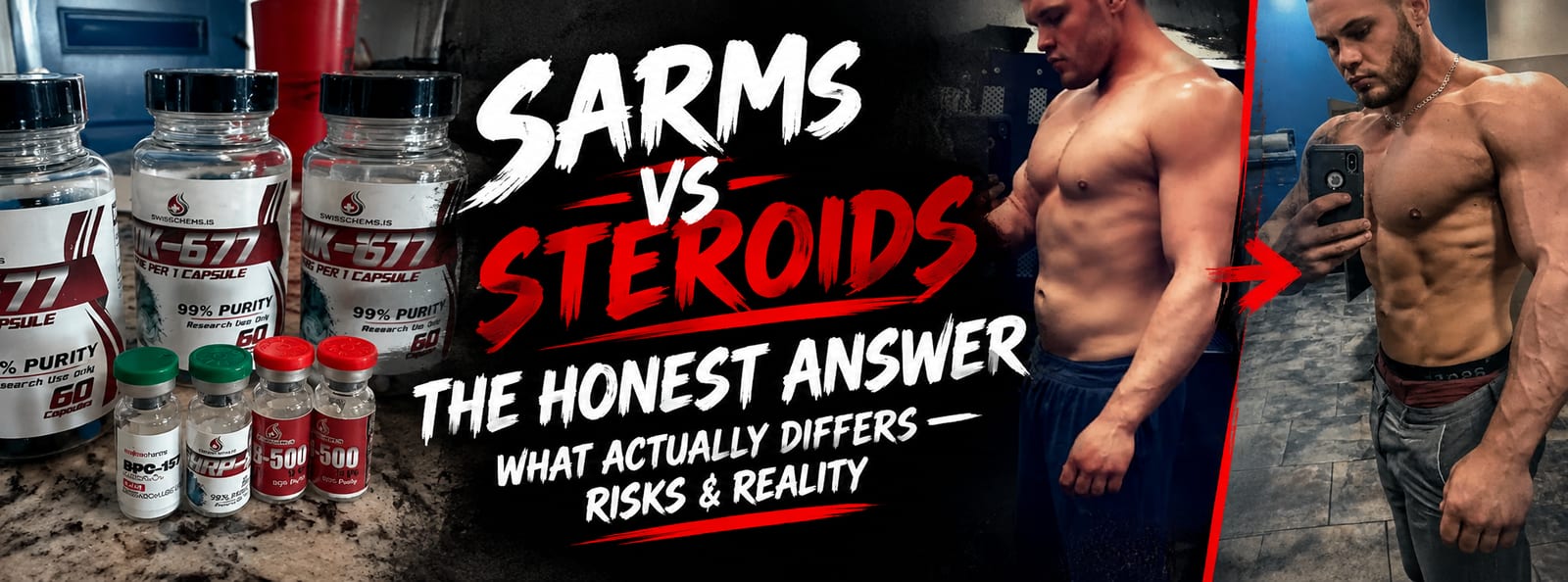
SARMs vs steroids, honestly: SARM suppression, results, side effects, the 'safe' marketing myth, and when a SARM is never the actual answer. The realistic…
SARMs vs steroids settled with zero marketing, explains SARM suppression, real results, the "safe" lie, side effects, and why the entire 'legal alternative' message falls apart. Honest comparison table included.
The question "SARMs or steroids?" has an answer problem: every source that profits off the confusion gives you a different one. The supplement-shop bro says SARMs are "legal, safe steroids, bro." The underground says they're "steroids with extra steps and less results." The worried parent says both are poison. Somewhere in that chaos is a straight answer, and since we already spend our time telling the truth about gear, we'll spend this one telling the truth about SARMs.
Selective androgen receptor modulators aren't poison, they aren't magic, and they aren't "nothing." They're a real class of compounds with real suppression, real side effects, and — for the goals most lifters actually have — a very different cost-benefit table than anabolic steroids. Here's the whole story, gloves off.
What SARMs Actually Are
SARMs (selective androgen receptor modulators) were researched to connect the anabolic/androgenic selectivity that steroids often split awkwardly. The premise: bind the androgen receptor for muscle-signaling benefits while sparing the other tissues — hence "selective." Politically, they got pushed as "steroids but safer" during a marketing era that needed a story to tell.
Before we get further, the uncomfortable foundation: SARMs still bind the androgen receptor and they still suppress your natural testosterone. The famous "less side effects than steroids" line is marketing-level marketing. The compound class has a genuinely different profile (less 5-alpha-reduction to DHT, less estrogen conversion in most cases), but "less of one thing" is not "none of anything."
SARMs vs Steroids: The Real Comparison Table
Let's put the honest differences on one page. What the marketing brochures won't tell you, side by side with what the underground never bothers to measure:
| Factor | SARMs | Steroids (injectable testosterone base) |
|---|
| Results per dollar | Modest at typical anted doses | Strong, inhalable, proven for decades |
| Suppression | Real; at clinical-scale doses often milder, at abused doses similar or worse | Count-on-it complete |
| Estrogen side effects | Lower estradiol conversion in most cases | Manageable but present (AI + e2 management) |
| Liver strain | Some SARMs are hard on liver markers, especially at the doses people actually run | Injectable test is generally easier on liver than oral AAS; orals are harder |
| Hair/prostate DHT drama | Generally milder on 5-alpha pathway | More DHT-driven on some compounds |
| What it's actually tested for | Human clinical data is thinner, and "user" doses exceed studies | Decades of medical + bodybuilding evidence |
| Blast-and-cruise, gains, longevity | Fads cycle, evidence is young | Battle-tested standard |
The single most useful sentence: SARMs are not "steroids, but without the side effects"; they're "androgen-pathway drugs that are less proven, differently dosed, and still suppressive — usually bought by people who wanted the easy label."
The Real Suppression Story (The Part That's A Famous Lie)
Here's the specific lie that costs honest people their cycles: "SARMs don't suppress your testosterone." They do. At the doses people actually run to see results — way above clinical trial doses — SARM users routinely report the shutdown-without-the-upside experience: LH and FSH drop, test tanks, and recovery becomes a mini-PCT problem.
What clinical trials showed was mostly short, low-dose, and in a population that wasn't trying to look like a bodybuilder. Nobody at 40mg of rad-140 a day is in "minimal suppression" territory. If you buy the "SARMs are gentle" story and run a heavy SARM stack, you can end up more suppressed than a modest testosterone cycle, with fewer proven gains to show for it.
The "Safe" Myth and Actual Side Effects
The safety marketing is built on "it's not a steroid, it's a SARM!" — for legal-adjacent reasons, not physiological ones. Real SARM complaints:
- Suppression and the post-cycle landing: crashes, libido loss, and the need for a restart plan some users never budgeted for.
- Liver enzymes: a few SARMs (especially the popular ones) show marked liver stress at real-world doses; TUDCA/NAC become a real topic, not a meme.
- Hair, mood, lipids: the well-reported class of complaints that just makes you sound like you're doing a homework assignment on AAS side effects, because you basically are.
- Unexplored unknowns: no decades of data, no long-run safety profile, and "user" doses that reliably exceed what anyone actually studied.
Meanwhile the alternative — a proper testosterone base with blood work and a plan — is the most documented performance-adjacent pathway there is. The "safer, bro" label doesn't hold up when you read the actual lancets and liver panels.
The Marketing Story, Laid Bare
Why does this narrative persist? Follow the money:
- "Legal" is the pitch. But legality isn't physiology; it's a regulatory category, and regulatory categories don't decide whether something suppresses your LH.
- "Natural-ish wellness" branding sells to a crowd that wants the result without the identity of being "a steroid user." That has zero bearing on what the compound does to your HPTA.
- Per-dose economics sound friendly at retail but deliver modest results, so users double the dose, which is exactly how the "mild" compounds get spicy.
The genuine utility for SARMs is narrow: some PCT-adjacent or bridging scenarios, some appetite/hormone-replacement-adjacent curiosities, and the fact that they're less dramatic on the 5-alpha/DHT pathway for hair-sensitive people. But nothing about that makes them "the easy, safe alternative" — it makes them "a different tool for a different, smaller job."
The "What If I Choose SARMs Anyway?" Protocol
There's a real population that will read this and still choose SARMs first — out of caution, curiosity, or because they got a bottle cheap. Gloves-off honesty means giving them a functional protocol, not just a lecture:
- Choose fewer, not more. One SARM at a time. "Stacking three for week one results" is how you turn a mild class into a harsh one while learning nothing.
- Get a baseline blood panel first. Testosterone, LH/FSH, liver, lipids. If it's bad before you start, a SARM makes it worse, not "safer."
- Dose toward the studied end, not the influencer end. The moment your dose exceeds what a human trial ever published, you've left the safety story and entered uncharted territory.
- Run the shortest effective cycle. Eight weeks beats twelve for the same diminishing returns, and the recovery math matters more than the extra pump.
- Plan the landing before the flight. Suppression is real; know your PCT and have it ready before your first dose, not after your hair falls out.
- Blood work at six weeks, no excuses. If the numbers scare you, that's the information you paid for. Listen to it.
This isn't endorsement — it's the minimum-viable-reality kit for someone who's going to do a thing anyway.
The Three Most Common Post-SARM Regrets
If you lurk long enough in the places where compound turnover actually happens, the same three regrets surface on repeat, and they make perfect sense given everything above:
- "I spent three months and 200mg of rad-140 a week to end up less anabolic than a real test cycle." Suppression happened, gains didn't match the stories, and the recovery cost was a mini-PCT anyway. This is the most-pirated lesson of the whole class.
- "The 'safe' label made me skip the doctor." Liver and lipid panels after real user-doses have sent more than one SARM fan to the same bloodwork conversation they thought they were avoiding by not touching "steroids."
- "I bought the legality, not the physiology." The regulatory sticker was the whole appeal, until they realized nobody at the gym, the mirror, or the blood clinic cares what aisle it came from.
Every one of those regrets is preventable — with blood work, honest dose discipline, and the first cycle guide that lays out what "doing it properly" actually looks like. The goal isn't to shame the choice; it's to make sure you make it informed.
The Bottom Line: SARMs vs Steroids, Honest
If you want one paragraph: SARMs are not poison, and they're not "steroids without sides." They're suppressive, real-dose-driven compounds with younger evidence, and the honest cost-benefit for serious muscle-building is usually worse than a testosterone-based cycle — at similar or worse suppression for similar goals. If you're already going to suppress your endocrine system, most experienced lifters would rather suppress it toward proven intramuscular gains with a real test base, blood work, and a restart plan than toward a herder's handful of pink pills that claim to be somehow above the law of the universe.
The only honest "safer" angle is dose discipline: whatever you choose, start moderate, test bloods, and run a real PCT. If you're not ready for suppression, outcomes, and a plan — you're not ready for either category. And if you just want the results, skip the purple-nutrition marketing and read our first cycle guide.
Real talk for people who pin (or who bought pink pills): sport is about doing the thing with your eyes open, not finding a label that lets you pretend the consequences don't exist. Molecule classes have consequences. Read the literature, run the plan, and pick the tool that actually fits the job.
Keep Reading
The Gear