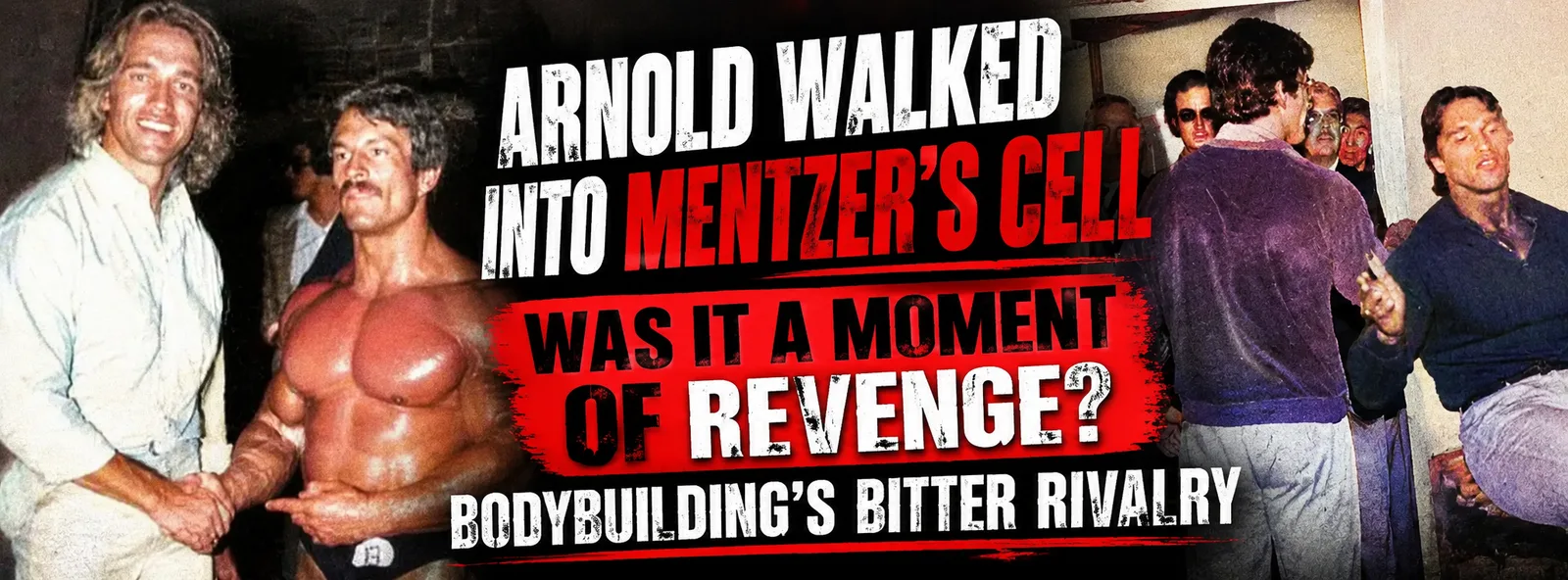
Arnold Schwarzenegger, Mike Mentzer, and an alleged jail visit years after their bitter Olympia rivalry. What happened, why was Arnold supposedly there, and how much of this disturbing story can actually be verified?
The Story Bodybuilding Still Whispers About Mike Mentzer’s Fall
There is a story that circulates in certain corners of the bodybuilding world with the quiet confidence of something everyone already half-believes. It goes like this: years after the 1980 Mr. Olympia, after the confrontation, after the retirement, after the long slide into amphetamines and institutional wards, Arnold Schwarzenegger walked into a jail or a psychiatric facility, looked at Mike Mentzer, and took a private moment of satisfaction at the sight of the man who had once challenged him reduced to that state.
Larry Pollock has told versions of it. The details shift depending on the telling, but the emotional payload stays consistent. The greatest political animal the sport ever produced coming to inspect the wreckage of the purest thinker it ever produced. It is a perfect little morality play if you already dislike Arnold, or if you need the 1980 result to feel like the beginning of a longer, more personal destruction.
The problem is that the story has never been independently confirmed. No contemporary newspaper, no court document, no second witness of any standing has ever placed Arnold inside a facility staring at Mentzer for the purpose of gloating. Mentzer was institutionalized more than once. He was arrested for bizarre public behavior. Those facts are real. The cinematic visit is not. It lives in the same category as a lot of bodybuilding lore: emotionally satisfying, endlessly repeated, and lightly attached to actual evidence.
That does not make the story worthless. It makes it revealing. The fact that people still need this particular scene tells you something about how unfinished the 1980 Olympia still feels to a certain generation of fans, and how badly some of them want a clean villain and a clean victim.
Sydney, 1980
Mike Mentzer walked into the 1980 Mr. Olympia with the kind of momentum that usually produces champions. The year before he had taken the heavyweight title with a near-perfect score. His physique had the dense, grainy quality that the judges of that era claimed to reward. More importantly, he carried an intellectual force that most competitors simply did not. He had already begun articulating the training ideas that would later become Heavy Duty. He spoke in the language of recovery, intensity, and rational limits at a time when the dominant culture still worshipped marathon volume.
Arnold had been gone for five years. Hollywood had claimed him. When he announced he would compete again in Sydney, the reaction among the athletes was not universal celebration. Mentzer was among those who saw the entry as political theater more than athletic ambition. The athletes’ meeting that followed has been described by Mentzer himself in consistent detail across multiple interviews. Arnold held court. Mentzer confronted him. Voices rose. Fingers were pointed. Joe Weider stepped between them. The contest went forward under a cloud that never fully lifted.
Arnold won. Mentzer placed fifth. The result remains one of the most disputed in the history of the Olympia. Mentzer believed the fix was in. Whether the judging was corrupted or simply reflected the enduring gravitational pull of Arnold’s name is a debate that will never be settled to everyone’s satisfaction. What is not debatable is the effect on Mentzer. He never competed again. The man who had built his identity around rational principles and competitive excellence walked away from the stage for good.
That fracture did not heal cleanly. Mentzer’s public comments about the contest remained sharp for years. Arnold later said the two men spoke by phone and put the matter behind them. Mentzer’s own recorded statements suggest the bitterness lingered longer than any single conversation could erase. The rivalry became one of the sport’s foundational myths: the charming operator versus the uncompromising rationalist. Every later discussion of Mentzer’s life has to pass through that night in Australia.
The Long Descent
What followed was not a graceful retirement into coaching and writing. Mentzer’s professional opportunities narrowed. The seminar circuit cooled. The magazine work that had once been steady became less reliable. Amphetamines, which he had used as a productivity tool during contest preparation and writing deadlines, escalated. Mentzer later described the period with unusual candor. He spoke of losing conceptual control, of thoughts that no longer tracked with reality, of a progressive inability to distinguish the rational from the irrational.
The behavior that followed is documented in the accounts of people who knew him and in Mentzer’s own later reflections. He was institutionalized multiple times. He was arrested for public incidents that ranged from the merely strange to the actively disruptive. Stories circulated of him running naked through streets, directing traffic, speaking in apocalyptic terms, waiting for extraterrestrial visitors. Peter McGough’s long profile of Mentzer captures the sense that a significant portion of the bodybuilding community had written him off as lost.
This is the window in which the jail-visit anecdote is usually placed. Mentzer was in and out of facilities. He was not serving a multi-year criminal sentence of the kind sometimes implied in the more dramatic versions of the story. He was a man whose mind had temporarily left the rails, and the system responded the way systems respond to people in that condition. The idea that Arnold arranged a personal viewing requires a level of personal vindictiveness and logistical coordination that has never been evidenced by anything beyond one man’s recollection decades later.
Larry Pollock’s broader claims about living with Mentzer, the extent of the methamphetamine use, and various personal propositions have been questioned by people who spent more sustained time with Mentzer during the relevant years. John Little, who knew Mentzer and has spoken publicly about the period, has noted inconsistencies in timelines and details. That does not automatically render every word of Pollock’s testimony false. It does place the stories in the category of contested personal recollection rather than settled historical record. The standard here is simple: when the only source is a single voice speaking years after the events, and when people closer to the subject push back, the claims remain unverified.
The Medical Endpoint
Mike Mentzer died on June 10, 2001, in Rolling Hills, California. He was forty-nine years old. His brother Ray found him. Two days later Ray himself died from complications of Berger’s disease after missing a dialysis appointment. The official determination centered on heart complications. Mentzer had severe atherosclerotic cardiovascular disease. He had suffered previous heart attacks. His left main coronary artery was significantly blocked. Morphine prescribed for pain management was present in his system.
The medical picture is consistent with what is known about many bodybuilders of that generation. Long-term anabolic steroid use, stimulant history, genetic predisposition, heavy smoking at various points, and the cumulative physiological load of extreme physique development all sit in the background as plausible contributing factors. None of them is a simple one-to-one cause. The heart failed. That is the documented endpoint.
Mentzer had a family history of heart issues. He had already been advised of serious cardiovascular problems in the years before his death, to the point that he was unable to serve as a kidney donor for his brother. The man who spent his competitive years preaching the primacy of recovery and the dangers of overtraining died of the organ most stressed by the pharmacological and lifestyle culture he operated inside. The symmetry is uncomfortable. It is also more useful than any unverified jail scene.
Why the Folklore Persists
Bodybuilding has always needed its saints and its villains. Mentzer is useful as the pure thinker destroyed first by politics and then by his own mind. Arnold is useful as the ultimate survivor who always landed on his feet. The jail-visit anecdote compresses an entire decade of decline, resentment, and myth-making into a single dramatic image. It is narratively efficient. Efficiency is not the same as accuracy.
The actual record is messier and more human. Mentzer was brilliant and rigid in equal measure. He was capable of extraordinary focus and of catastrophic loss of it. He recovered enough in the 1990s to train clients, write extensively, and influence the next generation of high-intensity advocates. Dorian Yates has repeatedly credited Mentzer’s ideas as foundational to the training approach that produced six Olympia titles. The later Mentzer was still opinionated, still philosophical, still carrying the scar of 1980. He was not the broken figure of the darkest mid-to-late 1980s years. Nor was his death the simple result of one rival’s long-distance satisfaction.
The culture that produced Mentzer also produced the conditions that made his decline possible. Amphetamines were common tools in that era for men trying to maintain the extreme focus required by both contest preparation and the side hustles that paid the bills. The psychological cost of tying one’s entire identity to competitive placement was rarely discussed until it became impossible to ignore. The political realities of the IFBB in the late 1970s and early 1980s rewarded certain kinds of personalities more than others. Mentzer’s refusal to play the political game was both a moral stance and a professional liability.
None of that requires a villain with a visitor’s pass. The more interesting story is the one Mentzer himself tried to tell in his later years: a man who looked at the irrational period of his life and attempted to extract principles from it. That self-examination is rarer and more valuable than the folklore that continues to surround him.
The Weight of the Record
The 1980 Olympia remains the hinge point. Everything before it is the rise of a competitor who seemed destined to redefine the sport. Everything after it is the long, uneven attempt to live with the consequences of that night. Mentzer’s training philosophy survived the personal collapse and found new life in the physiques of men who never met him. His writing continued to influence people who never saw him compete. The personal cost was real. The professional and intellectual legacy proved more durable than the darkest years suggested.
The unverified stories will keep circulating because they are dramatic and they flatter existing camps. The documented sequence is less cinematic and more instructive. A gifted competitor suffered a multi-year psychological crisis, recovered enough to resume productive work, continued to advocate a rational approach to training, and died of documented cardiovascular disease at forty-nine. The heart did not care about the 1980 result or the philosophical purity of the system that produced the physique. It only responded to the cumulative load placed on it over decades.
That is the part of the story that does not require embroidery. It is also the part that remains most relevant to anyone still trying to extract meaning from the life of a man who refused to train like everyone else and paid a price for it that the folklore has never fully captured.
Frequently Asked Questions
What was the official cause of Mike Mentzer’s death?
Heart complications. He had severe atherosclerotic cardiovascular disease, a history of previous heart attacks, and a significantly blocked left main coronary artery. Morphine prescribed for pain management was also present. He was found by his brother Ray on June 10, 2001.
Did Arnold Schwarzenegger visit Mike Mentzer in jail or a psychiatric facility?
No credible independent evidence supports the claim. The story appears in anecdotes told by Larry Pollock and has been repeated as bodybuilding folklore. Mentzer was institutionalized and arrested during periods of mental health crisis, but the specific visit for purposes of gloating has never been documented by any secondary source.
Was Mike Mentzer serving a long prison sentence?
No. The documented issues involved short-term institutionalizations and arrests related to bizarre public behavior during a multi-year period of psychological instability. He was not serving a multi-year criminal sentence of the kind sometimes implied in the more dramatic versions of the folklore.
How reliable are Larry Pollock’s accounts of living with Mentzer?
They are personal recollections delivered decades after the events. People who spent more sustained time with Mentzer during the relevant years have noted inconsistencies in timelines and details. The claims remain contested testimony rather than settled history. ( https://youtu.be/tiXEFberSTs?t=2599 )
Did the 1980 Mr. Olympia end Mentzer’s career?
It ended his competitive career. He never stepped on a bodybuilding stage again. He later rebuilt a significant presence as a trainer, writer, and influence on high-intensity training methods, most notably through his effect on Dorian Yates.
What role did amphetamines play in Mentzer’s decline?
Mentzer himself and contemporary accounts describe escalating amphetamine use that began as a tool for productivity and contest preparation. He later connected that use to the loss of conceptual control that led to the institutionalizations of the mid-to-late 1980s. He eventually stopped.
Is there a direct link between Heavy Duty training and Mentzer’s heart disease?
No. Cardiovascular disease in bodybuilders of that generation is more commonly associated with the combination of anabolic steroid use, stimulant history, genetic predisposition, and the overall physiological stress of extreme physique development. Mentzer had a documented family history of heart problems.
Did Mentzer and Arnold ever reconcile?
Arnold has stated that the two men spoke by phone after 1980 and put the conflict behind them. Mentzer's public comments remained critical for years. No detailed public record of a warm personal reconciliation exists.
What is the most accurate way to understand Mentzer's later years?
As a man who:
- Suffered a genuine multi-year psychological crisis
- Recovered sufficiently to resume productive work in the 1990s
- Continued to develop and promote a rational training system
- Died of documented cardiovascular disease at forty-nine
The dramatic folklore around jail visits and personal gloating is less useful than the actual sequence of events.